


Coding agentMetaConfirmed
Story 3 of 13 in the Friday 20 November editionMeta adds native GLB 3D model generation tools to Muse Code
Live on 20 November 2026 across macOS, Linux and Windows CLI sessions with Nano and Pro 3D tiers bundled into Muse Code plans starting at $5 per month.

 Edited by Ashutosh Shrivastava
21 Nov 2026, 08:30 IST · 3 min read
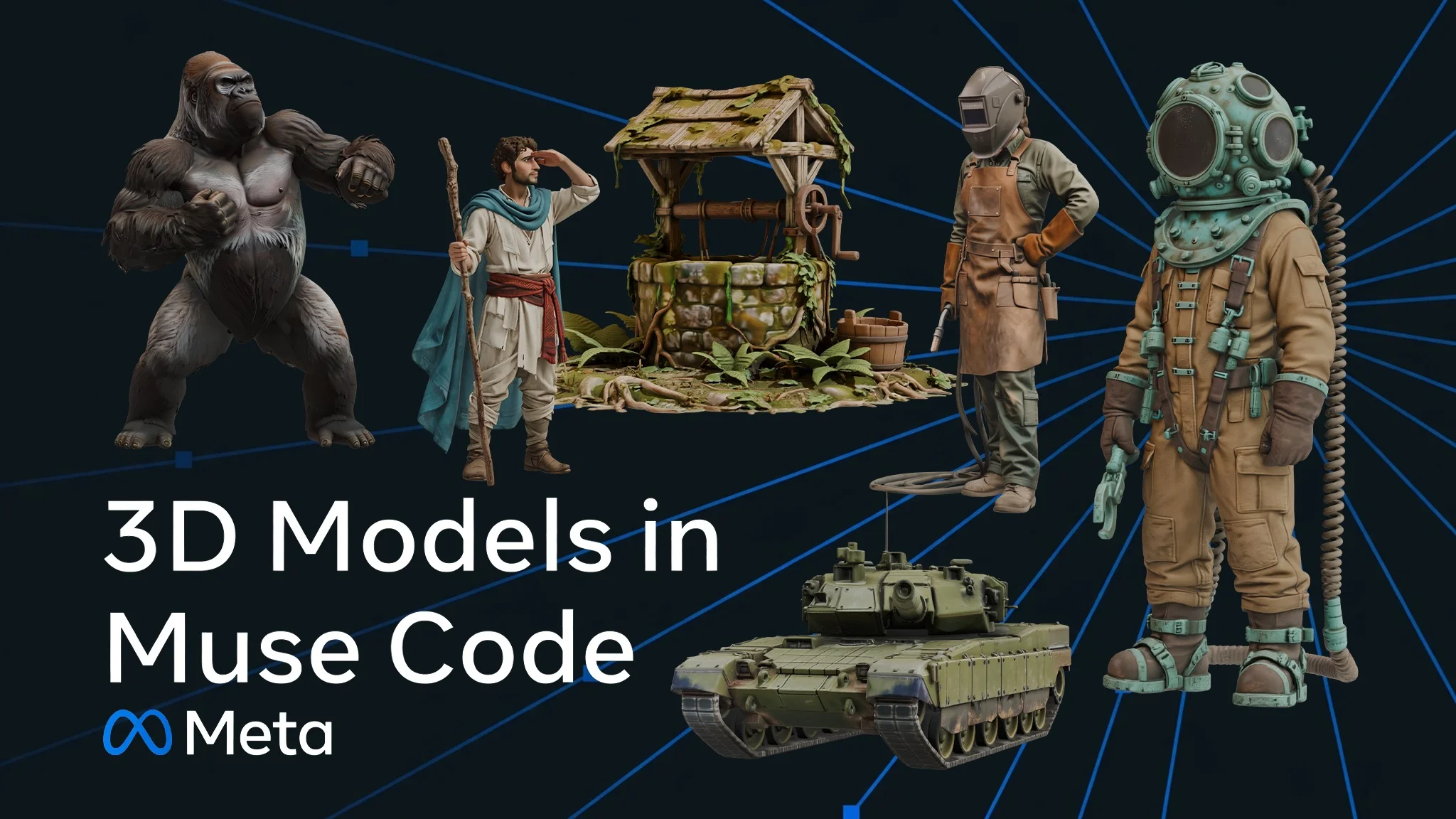
Meta launched native 3D modelling capabilities inside its Muse Code CLI coding agent on 20 November 2026 across macOS, Linux and Windows (installed via dev.meta.ai/install.sh). Muse Wonder, Muse Spark and Muse Ember can invoke built-in 3D tool calls alongside Muse Image inside an active coding session, turning text descriptions or single reference images into textured GLB meshes saved straight into the developer’s repository for games, 3D printing or web visualisations.
Nano and Pro 3D quality tiers, five-hour plan allowances and character rigging
3D asset generation draws from existing Muse Code subscription quotas without external 3D plugins or separate third-party subscriptions. Subscribers on the $5-per-month Everyday Usage plan generate roughly 30 textured 3D models per five-hour window using the faster Nano 3D model, while High Usage ($15, 5 times Everyday capacity), Power Usage ($50, 20 times capacity plus Muse Wonder Full) and Maximum Usage ($200, 80 times capacity) plans raise 3D volume limits and add the higher-resolution Pro 3D setting.
Meta noted that Muse Code does not include a built-in tool call for skeletal rigging or character animation, publishing a prompt workflow that pairs Muse Wonder Full with Mesh2Motion human skeletons and Blender automatic weights alongside downloadable Dungeon Crawler and 3D web viewer sample projects.
Technical details
- Output format and inputs
- Textured GLB 3D meshes generated from text descriptions or single reference images in-session
- Tool-calling Muse models
- Muse Wonder (including Muse Wonder Full), Muse Spark and Muse Ember alongside Muse Image
- 3D model tiers and plans
- Nano on $5/month Everyday Usage (~30 models per 5h); Pro added on $15 High, $50 Power and $200 Maximum plans
- Supported CLI platforms
- macOS, Linux and Windows via curl -fsSL https://dev.meta.ai/install.sh | bash
Release details & context
Single-image Pro mesh gallery and downloadable 3D project templates
On the Meta for Developers launch page, Meta published 25 interactive Pro-tier meshes generated from single 2D reference images across two categories: 15 environment and vehicle objects (such as a castle, cathedral, coral reef, gargoyle, bulldozer, vintage pickup and battleship) and 10 stylised or realistic characters (including a cyborg soldier, tuxedo gent, blue orc and mailbox monster).
To show end-to-end code and asset integration, Meta released two downloadable zip repositories built in Muse Code: a playable 3D Dungeon Crawler mini-game complete with enemies, traps and spells, and an interactive 3D apple-varieties comparison website.
Common questions
How many 3D models can Everyday Usage subscribers generate in Muse Code?
Subscribers on the $5-per-month Everyday Usage tier can create roughly 30 textured 3D models per five-hour usage window with the Nano 3D model before reaching their five-hour cap.
Can Muse Code rig and animate generated 3D characters automatically?
Muse Code has no built-in rigging or animation tool call, so Meta recommends prompting Muse Wonder Full to apply a Mesh2Motion human skeleton with Blender automatic weights and export a web animation viewer.
Editor’s weekly perspective
Coding agents, IDEs and software security: Bundles built-in text-and-image-to-GLB 3D mesh generation across Nano and Pro tiers in Muse Code from $5 per month.
Sources
- PrimaryMeta for Developers: Build 3D models with Muse Codedev.meta.ai
- OfficialMeta for Developers: Muse Code plans and pricingdev.meta.ai
- On XMeta for Developers (@MetaforDevs) Muse Code 3D asset launch post on Xx.com
Meta release timeline (11 launches tracked)
- Meta rolls out Muse Realtime Voice and expressive Avatars across mobile, web and Mac
Meta rolled out Muse Realtime Voice and expressive Realtime Avatars in the Muse app in the US, streaming 25 fps video at roughly 870 ms latency.
- Meta launches Spaces in Muse for custom interactive tools built from chat
Meta rolls out Spaces in Muse so users can build, pin, and schedule custom interactive trackers, dashboards, and mini-apps directly from chat.
- Meta rolls out specialized Muse and Meta AI models with Active Memory
Meta upgrades Muse and Meta AI with specialized models trained using Muse Wonder, lifting its Personal Superintelligence Index score from 38% to 47%.
- Meta launches Muse Ember small multimodal model at $0.10 per million input tokens
Meta launches its Muse Ember 1M-token multimodal model at $0.10 input and $0.50 output per million tokens across the Meta Model API, Google Cloud and wearables.