Lead storyModelGoogleConfirmed
Google opens Genie 4 interactive world model in Gemini API
Available in preview on 19 November 2026 via the v1beta Interactions API and Google AI Studio with real-time 720p WebRTC streaming and 48 kHz stereo audio.

 AI Compass
The day’s major AI releases, written up and sourced.
Thursday 19 November 2026 · 16 launches · the whole day in 14 minutes
Lead storyModelGoogleConfirmed
Available in preview on 19 November 2026 via the v1beta Interactions API and Google AI Studio with real-time 720p WebRTC streaming and 48 kHz stereo audio.
Google opened Genie 4 (models/genie-4) to developers on 19 November 2026 through the v1beta Gemini Interactions API and Google AI Studio, one day after Google DeepMind rolled out Genie 4 in Project Genie. Initialised via a world_setup event from a text prompt, a 16:9 reference image or both, the model streams continuous 1280x720 (720p) environments at 24 frames per second with synchronised 48 kHz stereo audio covering ambient soundscapes, effects and spoken character dialogue, applying SynthID watermarks to every frame.
Applications connect through the google-genai Python SDK or @google/genai JavaScript and TypeScript SDK over WebRTC for browser sessions (minting interaction-scoped ephemeral auth_token credentials on the server) or WebSockets for backend pipelines. Native keyboard and camera user_action events (key_w, key_a, key_s, key_d and arrow keys) respond in roughly 0.2 to 0.5 seconds across United States, Western Europe and Japan data centres, whereas mid-session text input prompts pass through Gemini world planning in 1 to 2 seconds to shift weather, lighting or objects live.
Genie 4 requires a paid Gemini API key and bills 240 video output tokens per frame (5,760 tokens per second at 24 fps, or roughly $0.10 per second including stereo audio), with sessions capped at 120 seconds. Because closing a browser tab or calling session.detach() leaves server-side generation running, developers must invoke session.complete() or session.cancel() explicitly to stop billing.
02ModelOpenAIConfirmed
Live on 20 November 2026 over WebRTC and WebSockets with a 128,000-token context window, sharper speech transcription and $0.05 per active minute.
OpenAI released GPT-Live-1.1 (gpt-live-1.1) in the OpenAI API on 20 November 2026 for full-duplex voice agents that listen and speak at the same time over WebRTC or WebSocket transports. Compared with gpt-live-1, the model transcribes incoming caller speech more accurately, holds regional accents and voice identity more consistently across languages, and follows plain-language instructions on when to hand off reasoning or tool execution via client or Responses delegation alongside models such as GPT-6.2 Astra and Sol.
Each voice session defaults to a 128,000-token context window (accepting up to 16,384 tokens of startup instructions and up to 128 prior messages totalling 8,192 tokens) and automatically spins up a summarised replacement voice engine in the background when usage passes 90%. Applications inject up to 500 tokens mid-call through session.instructions.append, session.thinking.append and session.commentary.append, and set store: true to fork saved conversations for evaluation trials.
OpenAI bills gpt-live-1.1 per second at $0.05 per active minute and $0.02 per minute on WebRTC sessions while inference is paused in standby.
03ProductGoogleConfirmed
Live on 20 November 2026 at no extra fee for Gemini 3.6 and Gemini 4 models, deferring function and remote MCP parameter schemas until needed.

Google launched Tool Retrieval in preview on 20 November 2026 on the v1beta Gemini Interactions API across Gemini 3.6 and all Gemini 4 models, including Gemini 4 Neon and Gemini 4 Hydrogen. Instead of passing tens of thousands of JSON Schema tokens on every request, developers declare a tool_search entry and set defer_loading: true (plus an optional short_description) on long-tail function declarations or remote mcp_server connections.
In default server-side mode, Gemini sees only the name and summary of deferred tools; when a task requires one, the model emits a tool_search_call step, the API injects the full schema in a tool_search_result step and Gemini emits the function_call inside the same HTTP round trip. Because deferred schemas stay out of the opening prompt, cached prompt prefixes remain intact across turns.
Applications with proprietary vector indexes or per-user tool permissions can set execution to client, adding one round trip to return dynamic function declarations mid-conversation. Google charges no separate fee for Tool Retrieval beyond standard model input and output token rates; generateContent is not supported.
04ProductGoogleConfirmed
Rolling out in the United States on 20 November 2026 for Google AI Plus, Pro and Ultra subscribers on Apple Silicon Macs running macOS Sequoia 15.0+.
Google began rolling out computer use inside the Gemini app for Mac (gemini.google/mac) on 20 November 2026, allowing users to hand off multi-step chores spanning local folders, desktop software and web browsers. Unlike foreground agents that hijack the active screen, Gemini clicks, scrolls, navigates menus and types inside an isolated background window rendered as a live preview inside the chat conversation, keeping the user’s main display and cursor completely free.
Before execution starts, users choose which macOS applications Gemini may access, watch each step live, pause the run at any moment and approve sensitive actions before they fire. Google demonstrated workflows ranging from converting a child’s butterfly sketch into a rigged 3D model inside Blender and batch colour-grading photographs to extracting weights and addresses from local PDFs for multi-box shipping forms and assembling Google Slides decks from regional dashboards.
Computer use is rolling out in English in the United States for personal Google accounts (aged 18 and over) on Google AI Plus, Pro and Ultra plans with Apple Silicon Macs on macOS Sequoia 15.0 or later, two days after Google expanded the Gemini app to Android Go edition phones.
05Open sourceNVIDIAConfirmed
Apache 2.0 Python runtime on NVIDIA Warp, Newton and TensorRT with commercial OpenUSD SOMA and Unitree G1 checkpoints, released on 19 November 2026.

NVIDIA released MotionBricks (NVlabs/motionbricks and nvidia/MotionBricks on Hugging Face) on 19 November 2026, open-sourcing the real-time latent generative motion framework from its SIGGRAPH 2026 paper (arXiv:2604.24833). Trained on more than 350,000 BONES-SEED motion-capture clips, a single neural backbone reaches 15,000 frames per second at 2 ms latency on TensorRT, filling 30 Hz transitions (6 to 16 tokens of four poses, or 0.6 to 1.9 seconds per chained step) between four recent context poses and up to four target poses.
Three learned networks share each generation: a root predictor for path and duration, a masked token transformer pose predictor and a multi-head VQ-VAE decoder. Reusable Smart Primitives snap locomotion and object interactions such as vaulting, crouch-strafing and sitting together zero-shot without animation graphs or retraining, complementing NVIDIA’s GR00T 2 robotics stack.
Built on NVIDIA Warp, Newton physics and TensorRT, the repository provides Apache 2.0 source code, CC-BY-4.0 documentation, Inbetweener and Scene Preview demos across six gait styles, two primitive and scene editors, and commercially licensed ONNX and SafeTensors checkpoints (under the NVIDIA Open Model Agreement) driving both OpenUSD SOMA human characters and Unitree G1 humanoid robots.
06Coding agentGoogleConfirmed
Shipped in Antigravity App v2.33.0+ for macOS, Windows and Linux, running projects, Git worktrees, agents and MCP tools directly on Linux SSH hosts.

Google announced native SSH host support in the Antigravity desktop app (v2.33.0 and later on macOS, Windows and Linux) on 19 November 2026, complementing browser-based Remote Control and Google-managed Remote Agents. Engineers connect to 64-bit x86_64 or arm64 Linux servers with glibc 2.26+ (such as Ubuntu 18.04+, Debian 10+ and RHEL 8+) from the sidebar, command palette (Connect to SSH Host) or ssh-host CLI launch flag, automatically provisioning ~/.antigravity-hub-server/ over standard OpenSSH keys, ssh-agent and ProxyJump.
Each host opens in its own (SSH: host) window where projects, Git worktrees, agent tools, the Linux terminal sandbox, side-panel terminals and host ~/.gemini/ skills, rules, hooks, plugins and MCP servers execute directly on the remote machine, pairing naturally with Google Antigravity Dynamic Workflows. Plugin and MCP OAuth sign-ins relay through the local browser, while the /browser command attaches to remote Chrome debugging on the Linux host.
Closing an SSH window, restarting the app or putting a laptop to sleep leaves the remote server and active agents running until Stop SSH Server is invoked. Google has not announced separate per-host SSH fees beyond standard Google Workspace, Pay As You Go, Pro, Ultra or Enterprise plans.
07CreativeIdeogramConfirmed
Available in the Ideogram web app and v2 REST API from $0.008 per image starting 19 November 2026, ranking first on Rapidata Multi-step Image Edit.

Ideogram released Ideogram 4.6 on 19 November 2026 across its web app and developer API, pairing native 4K generation (up to 4096 by 4096 pixels) with multi-turn image editing engineered to minimise pixel drift outside modified regions while improving colour accuracy and surface texture realism. On Rapidata’s Multi-step Image Edit leaderboard snapshot from 17 November 2026 (rendered as an HTML table on Ideogram’s model page), Ideogram 4.6 Precise Edit at High Quality ranks first overall with a score of 1,892 ahead of MAI-Image-2.6 and Qwen-Image-2.1-Pro (Thinking).
Internal High-quality evaluations on the model page also report higher usable-output rates than Ideogram 4.5 across character consistency (85%), exact brand colours, product details, product shots and masked touch-ups. Developers call POST /v2/image/precise-edit/ideogram-4-6 (accepting optional masks while preserving source dimensions) or POST /v2/image/generate/ideogram-4-6 (accepting prompts or up to five reference images) across Very low, Low, Medium and High quality modes.
API billing starts at $0.008 per image in Very low quality (capped at 2K), with outputs at 2K or below billed at the 2K tier and commercial rights included.
08ProductMicrosoftConfirmed
Live in limited experimental preview on MAI Labs from 19 November 2026, generating images in 10 to 20 seconds with object-level selection and sketch edits.

Microsoft (Microsoft AI) launched Canvas on 19 November 2026 as a limited experimental preview on MAI Labs (labs.microsoft.ai/?model=canvas), introducing an interactive visual workspace powered by its new MAI Image 2.7 Flash model two days after Microsoft unveiled seven MAI models and Maia 300 at Ignite 2026. Users start from a text description in the side panel, an uploaded photograph, a rough sketch or starter presets including Leopards at dawn, Blossom to honey and Rainy reading nook, producing one image per run in about 10 to 20 seconds.
Instead of regenerating an entire composition from scratch when refining details, Canvas lets users turn rough sketches into structured diagrams, click directly on an object inside the generated frame or swap a single word in the prompt panel to update just that element while keeping surrounding layout intact.
Microsoft notes that MAI Labs hosts experimental model previews where sessions are ephemeral and generated runs are not saved permanently to an account canvas. Microsoft has not announced standalone API access or token pricing for MAI Image 2.7 Flash.
09ProductPerplexityConfirmed
Rolled out in Perplexity Computer on 19 November 2026 after an eight-week production trial that lifted personal skill adoption to 72.9% and cut tool errors 11%.
Perplexity updated Brain, the personalised memory and workspace-wiki agent inside Perplexity Computer, on 19 November 2026 to automatically author and maintain self-improving agent skills from each user’s completed work, extending the platform’s recent Multiagent Computer and Teammates rollout. An internal improvement agent inspects full session trajectories covering tool calls, reasoning steps and final outcomes, proposing a new personal skill or revising an existing one only after recurring patterns establish clear evidence.
While personal skills adapt to individual workflows, shared built-in skills distributed to every Perplexity Computer user must pass paired replay against historical failure scenarios plus human engineer review before any update ships to production.
Chief executive Aravind Srinivas published metrics from an eight-week randomised controlled trial on live Perplexity Computer traffic: 72.9% of users in the treatment cohort received at least one auto-generated personal skill versus 6.5% who added a skill manually, reducing tool-call failures by 11% and dissatisfied threads by 7.6% with zero measurable increase in cost or latency.
10Coding agentCognitionConfirmed
Live at app.devin.ai/security on 20 November 2026 with Agentic MapReduce repo scanning, Auto-triage and open-source NGINX2Root and Java4Shell fix skills.

Cognition launched Devin Security Threats (app.devin.ai/security) on 20 November 2026, pairing a managed index of newly disclosed software vulnerabilities with one-click repository scanning and pull-request remediation atop Devin’s Agentic MapReduce engine, expanding the multi-agent platform behind Devin Bots. Selecting Scan with Devin launches a Focus on threats sweep across chosen repositories, ranks findings against the organisation’s threat model and assigns confirmed issues to Devin to draft reviewable fix PRs.
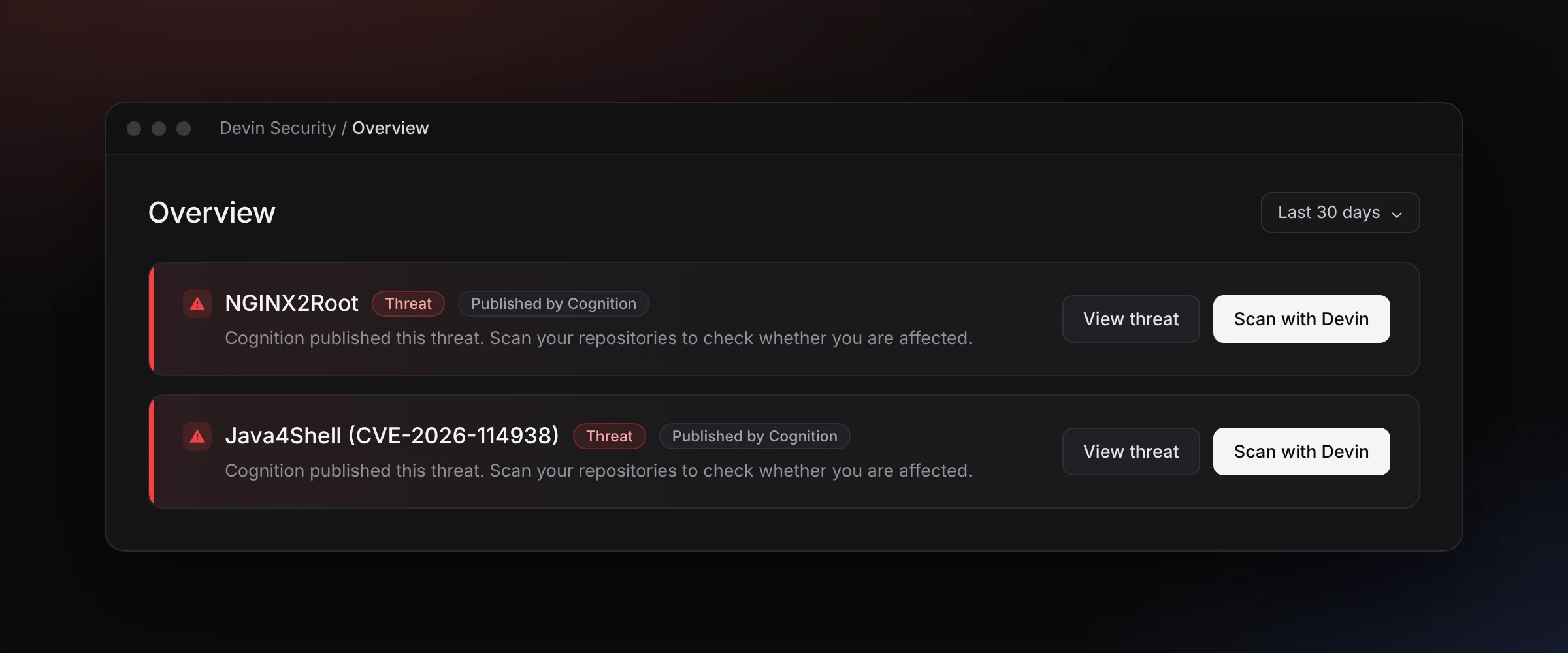
Security teams can enable Auto-triage with repository lists and minimum severity thresholds so Devin scans automatically whenever Cognition publishes a new advisory (optionally auto-dismissing clean runs), or author custom internal threats from bug bounty reports, vendor notices and incident reviews.
At launch, Cognition published threat definitions alongside open-source plain-Markdown skills (fix-nginx-vuln and fix-java-vuln in the Devin Marketplace Vulnerability Fixes plugin and Devin CLI) targeting Java4Shell (disclosed 17 November 2026) and the five memory-corruption bugs in NGINX2Root (disclosed 18 November 2026).
11Coding agentOpenAIConfirmed
OpenAI detailed Performance Factory on 19 November 2026, an internal cloud Codex orchestration system combining Markdown task state machines, event subscriptions, a perf-forensics skill and adversarial Codex reviewers that tracked more than 1,700 ChatGPT performance investigations (17 per day) and root-caused over 600 regressions in three months, grading 70% accurate in a 100-case manual audit.
SourcesOpenAI Engineering: How OpenAI’s Performance Factory keeps ChatGPT fast · OpenAI Developers (@OpenAIDevs) Performance Factory post on X
12ProductOpenAIConfirmed
OpenAI updated the Responses API on 20 November 2026 so persisted reasoning items on GPT-6.2 models (gpt-6.2-astra and gpt-6.2-sol) bind to the preceding conversation prefix and safety_identifier, delivering higher prompt-cache hits and lower token usage while automatically dropping invalidated reasoning (prefix_mismatch or end_user_mismatch) if earlier messages are edited.
SourcesOpenAI API Docs: Reasoning models · OpenAI Developers (@OpenAIDevs) Responses API reasoning history post on X
13ProductOpenAIConfirmed
OpenAI Codex and dots lead Thibault Sottiaux announced on 20 November 2026 that persistent proactive dots agents began rolling out to all ChatGPT Business Standard users and entered limited testing with a small cohort of ChatGPT Plus subscribers following proactivity improvements.
SourcesOpenAI Developers: Dots enterprise admin guide · Thibault Sottiaux (@thsottiaux) ChatGPT dots rollout post on X
14ProductOpenAIConfirmed
OpenAI rolled out ChatGPT Health across additional surfaces in the United States on 20 November 2026, adding sleep and workout analysis on the desktop app and Android (via Android Health Connect for Free, Go, Plus and Pro users), marathon training trackers on ChatGPT Sites (Plus and Pro) and proactive workout rescheduling in dots (Pro).
15ProductGitHubConfirmed
GitHub launched reachability analysis for Dependabot alerts in free public preview on GitHub Enterprise Cloud on 20 November 2026 (requiring no Code Security licence or billed Actions minutes), running daily CodeQL static call-path scans across JavaScript and TypeScript repositories with npm, pnpm or Yarn lockfiles and exposing verdicts in the UI and REST API.
SourcesGitHub Docs: About reachability analysis for Dependabot alerts · GitHub (@github) Dependabot reachability preview post on X
16ProductArtificial AnalysisConfirmed
Artificial Analysis updated its Pro Data Playground on 20 November 2026 with custom weighted benchmark indexes (scoring models evaluated across every selected test), arithmetic log/sqrt formula metrics, launch-date frontier playback, heat maps and open-versus-proprietary box plots, after adding free account follows for model creators and API providers on 19 November 2026.
SourcesArtificial Analysis (@ArtificialAnlys) Data Playground custom index post on X · Artificial Analysis (@ArtificialAnlys) creator and provider follow post on X


16 launches from Thursday 19 November 2026, edited by . The next edition is out between 11:00 and 12:00 IST.
Spotted an error? Email aiforsuccess.in+compass@gmail.com or tag @ai_for_success on X
Wednesday 18 November
Tuesday 17 November
Monday 16 November
Friday 13 November
Thursday 12 November