Rolling out on 18 November 2026 across Google AI Studio, Google Antigravity, the Gemini app, GitHub Copilot and Cursor with a 1M context window and four thinking levels.
Google and Google DeepMind launched Gemini 4 Neon (gemini-4-neon) on 18 November 2026, slotting a frontier reasoning model between Gemini 4 Hydrogen and Gemini 4 Carbon for repository engineering, multimodal analysis and scientific tasks. Adapted from Carbon with a March 2026 knowledge cutoff, Neon processes text, image, video, audio and PDF inputs inside one unified 1,048,576-token window, returning up to 65,536 synchronous output tokens or 1,048,576 tokens through background long decode. Paid Gemini API billing is $3 per million input tokens, $15 per million output tokens including thinking tokens and $0.15 per million implicitly cached tokens, with no free tier.
Thinking levels, coding benchmarks and day-one IDE rollouts
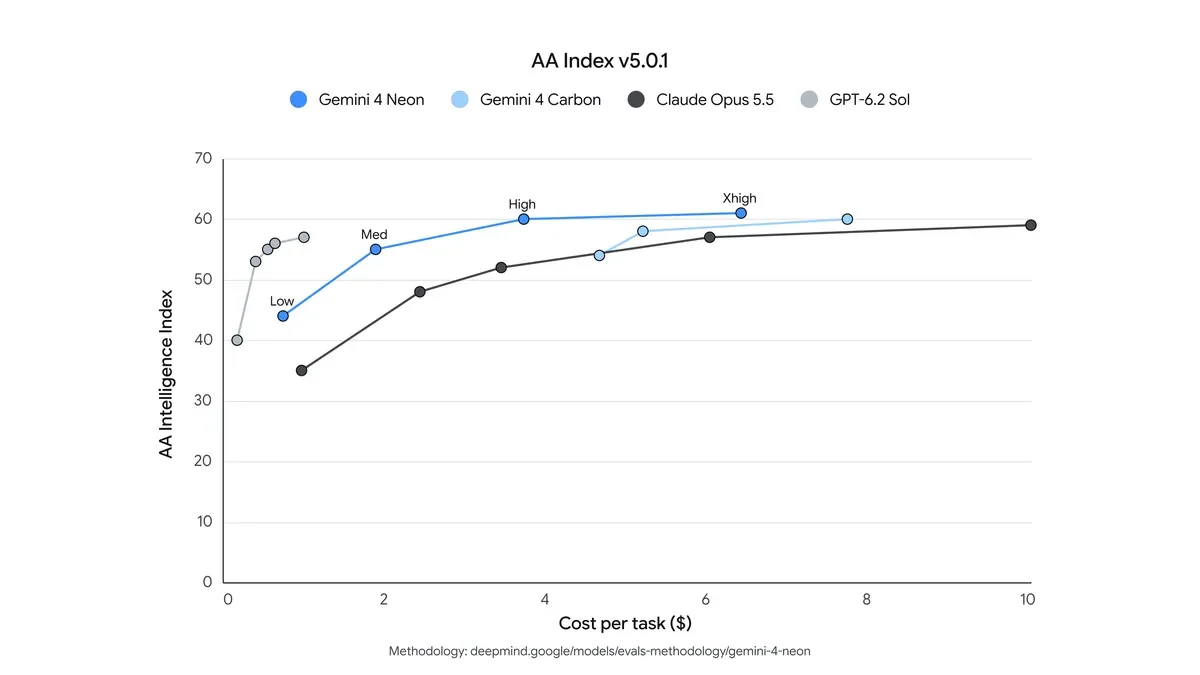
Developers tune reasoning across low, medium, high (default) and xhigh levels on generateContent and the Interactions API. At default high effort, Neon cuts per-task token cost by 32% against Carbon; at xhigh, it ranks third overall on the Artificial Analysis Intelligence Index (61) and second on both the Vals Index (70.9%) and Arena’s Agent Arena Index (1336 across 4,200+ sessions).
Across four thinking levels, Gemini 4 Neon reaches 61 on AA Index v5.0.1 while cutting default-high cost per task by 32% against Carbon.Image: Google
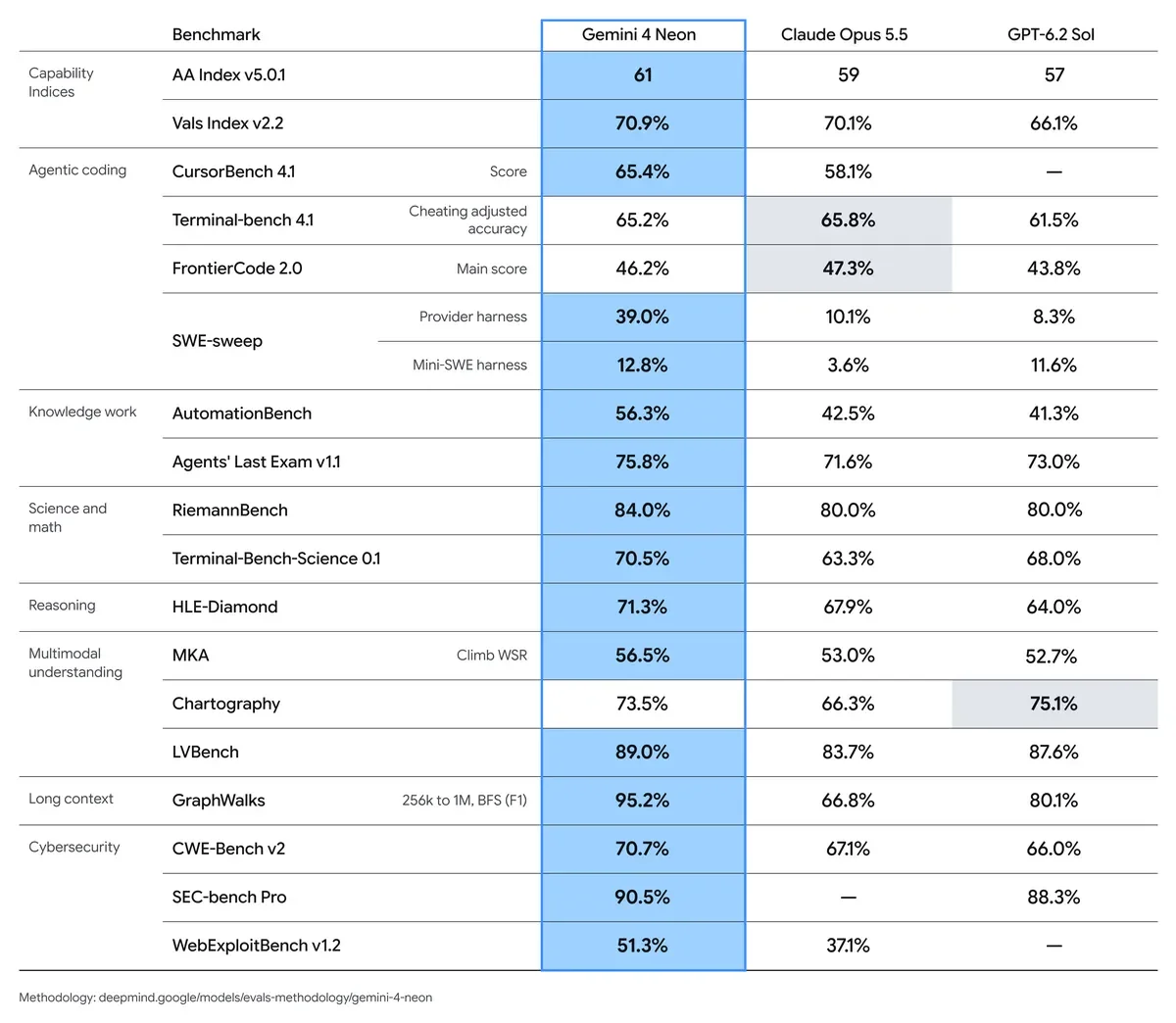
Across agentic coding, Neon tops the Artificial Analysis Coding Agent Index (58.6) and reaches 39.0% on SWE-sweep inside Google Antigravity, more than triple its 12.8% mini-SWE score. Google’s benchmark table lists 65.4% on CursorBench 4.1, whereas Cursor reported 63.7% at default effort (up from 57.3% for Hydrogen). Neon rolls out across Google AI Studio, Gemini for business, Gemini Managed Agents, Google AI Pro and Ultra plans in Antigravity and the Gemini app, Cursor and generally available GitHub Copilot Pro+, Max, Business and Enterprise tiers.
Google’s evaluation table compares Gemini 4 Neon against Claude Opus 5.5 and GPT-6.2 Sol across coding, science and cyber tests.Image: Google
Available on 18 November 2026 in the browser for eligible Google AI Ultra subscribers with Pro waitlist sign-ups, conversational world building and remixing.
Google DeepMind and Google Labs began rolling out Genie 4 inside the browser-based Project Genie platform on 18 November 2026 for eligible Google AI Ultra subscribers, while opening a waitlist for Google AI Pro members. Unlike earlier static prompt-to-world prototypes, Genie 4 lets users type natural-language prompts mid-session while navigating an interactive 3D space to change weather, spawn characters or redirect events on the fly, paired for the first time with adaptive real-time native audio spanning ambient soundscapes and character dialogue.
Conversational Project Genie agent, community gallery and Genie 3 upgrades
A new conversational Project Genie agent coordinates Google’s multimodal and Gemini models to establish a world’s visual look and custom mood-matched background score from plain dialogue. During live exploration, Gemini watches the screen to surface context-aware suggestion chips or trigger in-world events automatically, complementing physical-simulation work such as Google DeepMind’s Gemini 4 Hydrogen robotics plugin.
Creators can publish and remix interactive worlds in a new community gallery seeded with collaborations including creative technologist Will’s gothic mystery Villa Giallo and filmmaker Anand Gandhi’s colony simulation The Life of Ants. Alongside Genie 4, Google kept an upgraded Genie 3 in Project Genie’s model picker for 3-minute runs (up from 60 seconds), multi-world chaining and 360-degree panorama grounding. Google DeepMind has not announced standalone API access for Genie 4.
Opening via global waitlist on 18 November 2026 with Google AI Ultra priority, pairing GitHub repositories and 180+ telemetry connectors with human PR approval.
Google Labs introduced Stitch Loop on 18 November 2026 as an always-onpost-launch product agent experiment inside Stitch, opening a global waitlist at stitch.google.com/loop/waitlist with priority access for eligible Google AI Ultra subscribers. Rather than stopping once an initial feature merges, Stitch Loop connects a team’s GitHub codebase to live production logs, user behaviour and customer feedback through more than 180 integrations, custom MCP servers or local CLI uploads.
Four-stage evergreen loops, CodeMender security scans and Antigravity context
Every loop iterates continuously through four stages: surfacing evidence-backed Suggestions, scoping Solutions with trade-offs and visual UI options, writing code in an isolated cloud sandbox to open a GitHub pull request with screenshots and videos (Build), and tracking live post-merge metrics so regressions trigger fresh passes (Reflect). Nothing merges until a human reviews and approves the pull request.
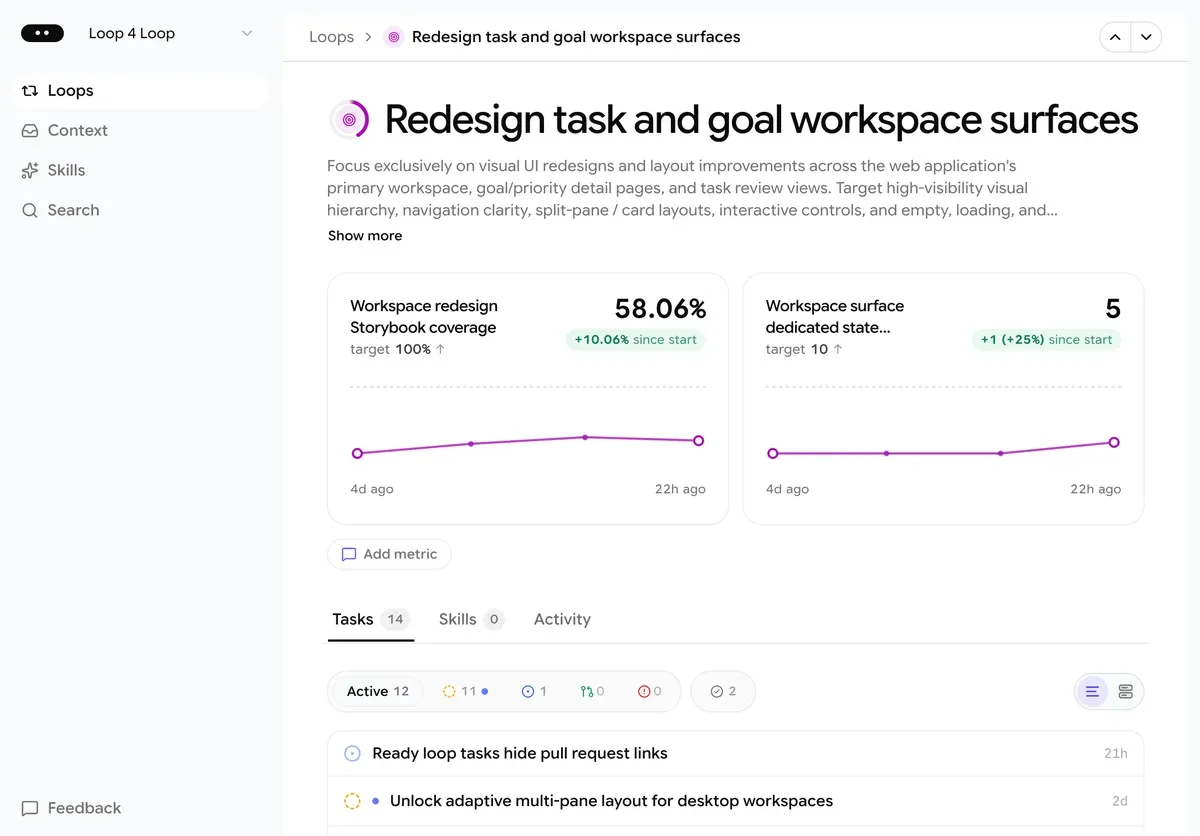
Stitch Loop tracks live outcome targets such as Storybook coverage alongside queued pull-request tasks in one workspace.Image: Google
Out of the box, Stitch Loop ships built-in loops for latency, accessibility and cybersecurity, where the security loop combines Gemini 4 Carbon with Google DeepMind’s autonomous CodeMender agent to flag vulnerabilities and draft patches, alongside custom loops such as checkout conversion. External coding agents including Google Antigravity can pull persistent product context via the Stitch CLI and MCP, while @stitch posts daily digests in Slack. Google has not announced Stitch Loop pricing.
Live on 18 November 2026 at POST /v1/context, returning clean Markdown, HTML, links, query highlights and Open Graph metadata with zero charge on failed URLs.
Perplexity launched the Perplexity Context API (POST /v1/context) on 18 November 2026, adding a parallel web-page extraction primitive alongside its Orchestrator API and Monitor API. Each request accepts 1 to 10, 15 or 25 HTTP/HTTPS URLs by usage tier (up to 50 on raised limits) and returns ordered per-page Markdown, raw HTML, deduplicated absolute links, query-matched passage highlights (1 to 4,096 tokens per URL, default 1,024) and Open Graph metadata.
Freshness controls, per-URL fault isolation and 715-site benchmark scores
To build Markdown, Context API splits each document into blocks and runs a classifier model to strip cookie banners, navigation and ads while keeping verbatim source passages. By default it serves copies from Perplexity’s index fetched within the prior two days before live fetching, with overrides for max_age_seconds (0 for forced live reads up to two years), cache_only, if_modified_since and 1-to-5 decision criteria questions.
URLs execute in parallel with independent timeouts (1,000 to 110,000 ms overall, or 95,000 ms with criteria), billing $1 per 1,000 URLs returning ok ($0.001 per URL) and $0 for failed fetches. Across thousands of agent URLs spanning 715 sites judged blindly against Firecrawl, Exa, Parallel, Keenable and Context.dev, Context API scored 92.3% usable content, 87.9% fact recall and 80.3% content precision.
Available on 18 November 2026 for local and remote coding-agent sessions with a Linux release planned and replenished free Pro trial coupons for builders in Europe.
Mistral AI launched Mistral Vibe on Desktop for macOS and Windows on 18 November 2026, with a Linux version listed as planned, bringing local repository coding agents and remote cloud execution into a single desktop application. Alongside the rollout, Mistral replenished its LECHONK coupon code so developers in Europe can test the Vibe Pro plan free of charge after the initial batch ran out on 17 November.
Unified Work and Code modes, 100+ MCP connectors and enterprise consoles
Formerly known as Le Chat, Vibe merges Mistral’s conversational assistant and long-horizon agent stack across web, mobile, terminal, IDE and desktop surfaces, building on Mistral Studio’s Managed Agents expansion. Vibe for work pairs a fast-versus-think depth toggle with Voxtral voice input, @Skills and over 100 connectors and MCP integrations spanning GitHub, GitLab, Jira, Slack, email and calendars, while Vibe for code handles multi-file scaffolding, regression test generation, dependency migrations and asynchronous pull requests.
Vibe Desktop sits alongside the Python 3.12 mistral-vibe CLI (installed via uv tool install to expose vibe and vibe-acp for Visual Studio Code, JetBrains and Zed), supporting Mistral subscriptions, offline local models, OS-keyring API keys and self-hosted enterprise consoles pinned with VIBE_CUSTOM_CONSOLE_URL.
Available on 18 November 2026 with a first-party OpenAI Accounting plugin, computer-use fallback and connectors for Xero, BILL, FreshBooks, Rillet and Campfire.
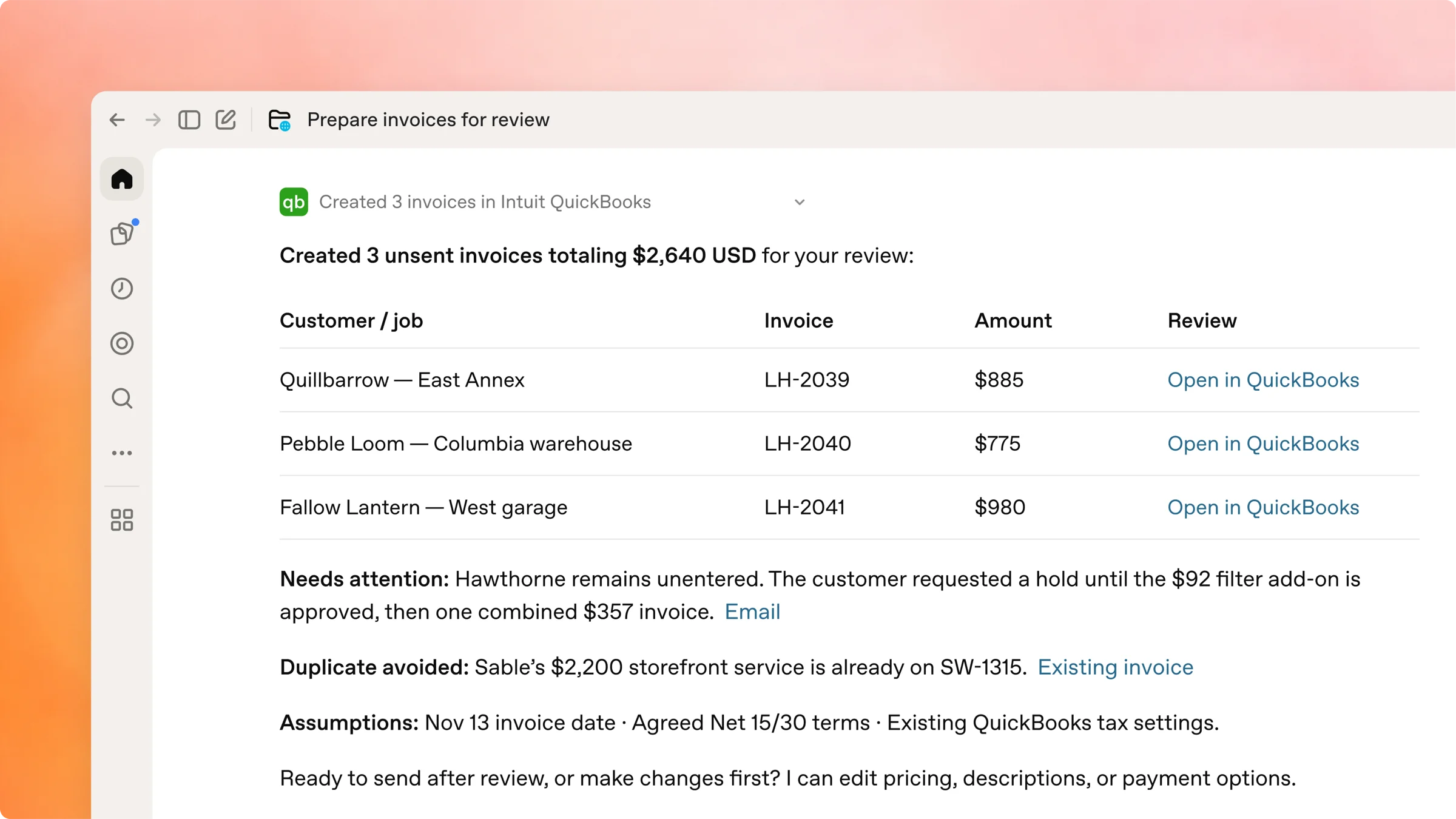
OpenAI launched ChatGPT for Accounting on 18 November 2026 at openai.com/business/solutions/accounting, extending its vertical workspace suite one day after ChatGPT for Sales. The release combines a first-party OpenAI Accounting plugin with partner connectors for Intuit QuickBooks, Xero, Oracle NetSuite (plus NetSuite QuickStart), BILL, FreshBooks, Rillet and Campfire, while ChatGPT computer use steps in for legacy or specialist accounting apps without a native plugin.
Invoice coding, bank reconciliation, workpaper checks and reusable close skills
The Accounting plugin structures four recurring finance workflows across email, uploaded spreadsheets and connected ledgers: preparing draft journal entries and customer invoices from emails and receipts with suggested account codes while holding unclear items for review; gathering statements and payment records for bank reconciliation; comparing workpapers against supporting documents to flag duplicates, missing fields or unexplained variances; and saving monthly closing instructions as reusable skills.
Workspace administrators govern which accounting connectors are enabled, individual users sign in with their existing app permissions, every draft entry waits for human sign-off before posting, and ChatGPT Business and Enterprise data is excluded from model training by default. OpenAI has not announced API or commercial pricing.
Instruct, FP8 and pretrained base checkpoints with DFly2 speculative decoding weights under the Tencent Hy License across Hugging Face, ModelScope and GitCode on 18 November 2026.
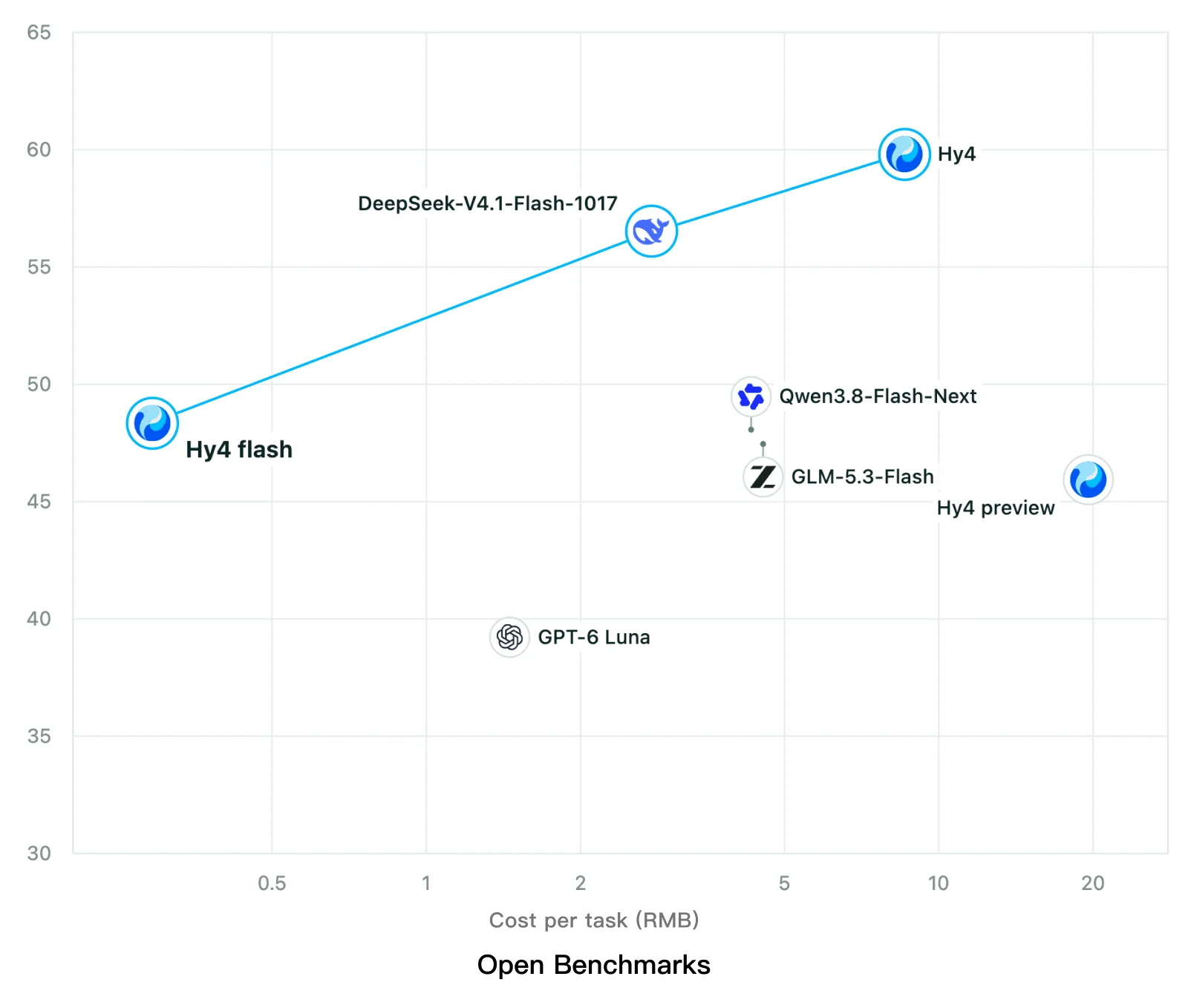
Two days after launching its hosted Hy4 flash API, Tencent Hunyuan released open weights on 18 November 2026 for tencent/Hy4-flash, tencent/Hy4-flash-FP8 and the pretrained tencent/Hy4-flash-base checkpoint across Hugging Face, ModelScope and GitCode under the Tencent Hy License. Listed on the Hugging Face Hub at 220 billion total parameters including 64 billion Engram lookup parameters (224 billion in Tencent’s earlier research note) with 12 billion active parameters per token, the natively multimodal Mixture-of-Experts model accepts text and image inputs across a 1-million-token context window.
Across seven public agent benchmarks, Hy4-flash leads the low-cost frontier ahead of Qwen3.8-Flash-Next and GPT-6 Luna.Image: Tencent
LatentMoE KV-cache compression, vLLM and SGLang serving, and DFly2 decoding
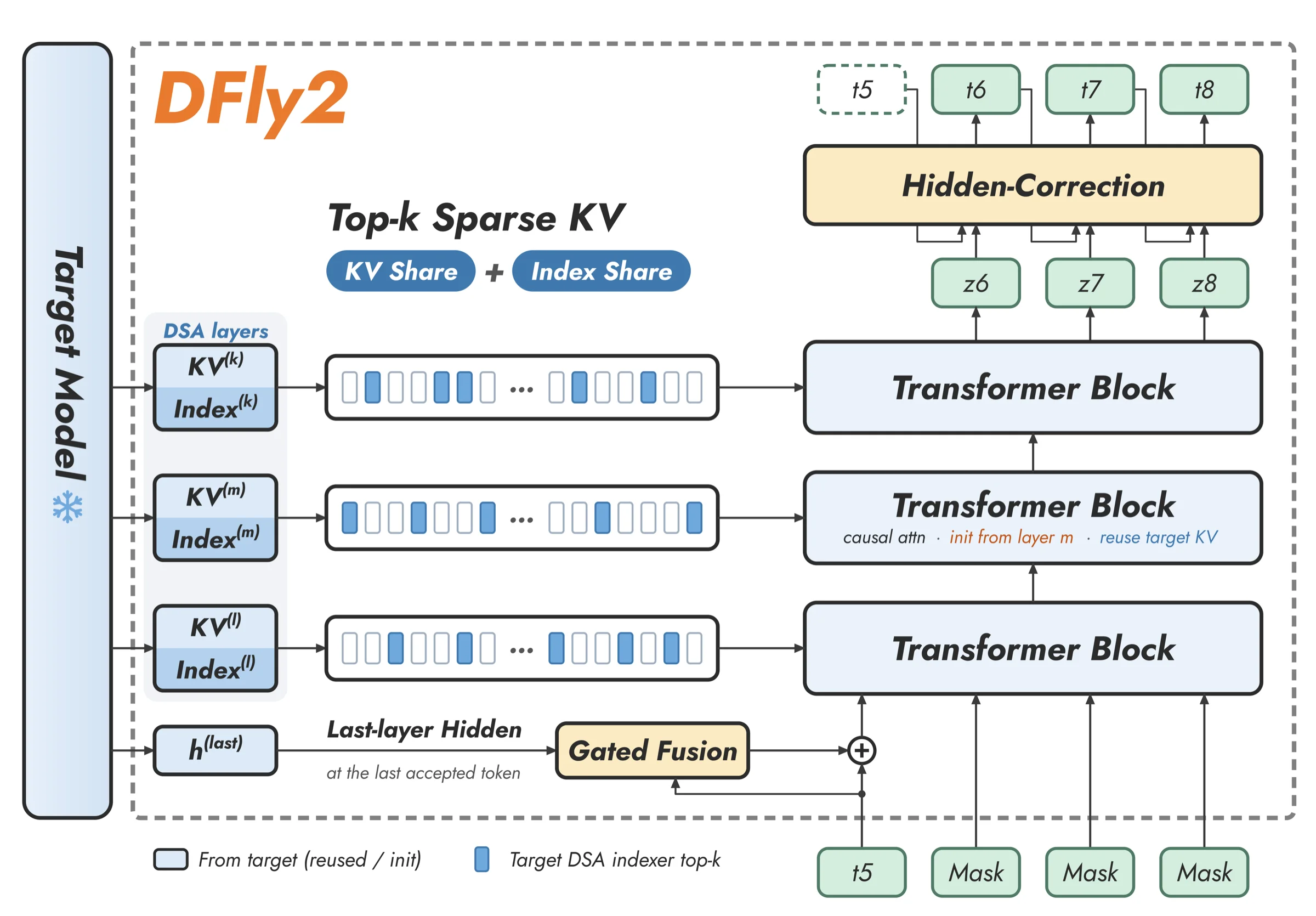
Hy4-flash pairs hybrid attention, LatentMoE and Engram tables to compress KV-cache memory to one-sixth of flagship Hy4 while halving average output token length through self-distillation and reinforcement learning. Alongside the full-precision and FP8 checkpoints, Tencent released DFly2 speculative decoding weights that reuse target top-k sparse KV states and hidden-layer corrections across draft blocks.
Tencent’s companion DFly2 speculative decoder reuses target top-k sparse KV caches and last-layer hidden states via gated fusion.Image: Tencent
Developers can run the weights locally or on private clusters through Hugging Face Transformers (image-text-to-text), vLLM, SGLang, Docker Model Runner (hf.co/tencent/Hy4-flash) and community GGUF quantisations for llama.cpp, Ollama and LM Studio.
Rolling out on 18 November 2026 across all Copilot plans for Supabase, Box, Buildkite, Calendly, ClickUp, Mixpanel, Webflow and Wix across IDE, CLI and web.
GitHub rolled out eight new GitHub-verified Model Context Protocol (MCP) server connectors in public preview across all Copilot plans on 18 November 2026, expanding Copilot’s pre-vetted integration catalogue past 33 services alongside Slack, Figma and Sentry, and following GitHub’s Ignite browser and Azure DevOps previews. The new connectors add Supabase for database projects and schemas, Buildkite for CI pipelines and failed builds, Box for content search and Box AI, ClickUp for tasks, Mixpanel for product analytics, Calendly for scheduling, and Webflow and Wix for site management.
Sign-in-once setup across CLI, VS Code, Copilot app and enterprise policies
Instead of hand-editing local MCP JSON server files on each machine, developers connect a service once via OAuth - through Customize in the Copilot app, the /mcp Connectors tab in Copilot CLI, Agents Customizations in Visual Studio Code or the Copilot customisation page on github.com - and reuse that authenticated link across every surface.
In a single coding session, Copilot can inspect why a Buildkite pipeline failed before patching the repository or verify a live Supabase table schema prior to generating a SQL migration. On Copilot Business and Enterprise plans, administrators must enable the Editor preview features policy and add the new servers to any explicit non-wildcard MCP allowlist.
Rolling out on 18 November 2026 with isolated per-preview stateful servers and user-scoped SaaS integrations as annual recurring revenue nears $130 million.
Netlify unveiled a redesigned full-stack AI application platform on 18 November 2026, reporting that it is on track to approach $130 million in annual recurring revenue by the end of 2026 (nearly 130% year-over-year growth) amid up to 100,000 daily signups and over 1 million new projects created weekly. Live immediately for most new users with a gradual rollout to existing accounts, the workspace lets nontechnical teammates prompt apps through Agent Runners while developers commit to the same Git repository from IDEs or coding agents.
Stateful Netlify Server deploy previews and 150+ user-scoped connectors
To support workloads beyond static front ends and short-lived serverless calls, Netlify launched Netlify Server - already running more than 10,000 servers - for persistent WebSocket connections, real-time chat and long-running AI agents alongside managed front ends and databases. Every deploy preview automatically receives its own isolated server environment before changes merge to production.
Available on Credit and credit-based Enterprise plans, Agent Runners now connect to over 150 external services including Linear, Notion, Jira, GitHub, Snowflake, Databricks, Datadog, Stripe, PayPal, Plaid, HubSpot, Salesforce, Clay and Slack. Connections stay strictly private per user under Project Overview Connectors, while runtime secrets save as project environment variables.
Priced on 18 November 2026 above its $70 to $78 roadshow range for an $81.34 billion base offering, with Nasdaq Global Select trading set for 19 November.
Anthropic, PBC announced on 18 November 2026 that it priced its initial public offering of 980,000,000 shares of Class A common stock at $83 per share, topping the $70 to $78 range set when Anthropic opened its IPO roadshow on 10 November. Following the US Securities and Exchange Commission’s declaration on 18 November that its registration statement is effective, the base offering values the total share sale at $81.34 billion.
Primary share proceeds, selling stockholders and 147M-share greenshoe
Anthropic itself is selling 956,351,354 Class A shares - equating to $79.38 billion in gross primary proceeds before underwriting discounts and offering expenses - while existing selling stockholders are offering 23,648,646 shares ($1.96 billion), from which Anthropic receives no proceeds. Anthropic also granted the underwriters a 30-day option to purchase up to 147,000,000 additional Class A shares, worth up to $12.20 billion at the $83 IPO price.
Shares are scheduled to begin trading on the Nasdaq Global Select Market on 19 November 2026 under the ticker symbol ANT and close on 20 November 2026 subject to customary closing conditions, with Goldman Sachs & Co. LLC and Morgan Stanley & Co. LLC serving as prospectus contacts.
OpenAI opened a public beta on 18 November 2026 for discounted completion windows in Responses API background mode across GPT-6.2 Astra, GPT-6.2 Sol, GPT-6.1 Terra and GPT-6 Luna, offering 30% off Standard token rates for a 2h target and 40% off for an 8h target across single-turn and multi-turn tool workflows since GPT-6.2 omits Flex processing.
OpenAI reported on 18 November 2026 that its models rewrote SystemVerilog RTL to deliver up to 14% power, performance and area gains on AMD flagship GPU IP in under five months (with changes already sent for manufacturing), verified silicon area cuts of 13% and 10% on its custom Jalapeno inference chip, and partnered with Synopsys to train GPT-Synopsys on commercial EDA tools.
OpenAI published its Jagged Frontier internal research-acceleration study on 18 November 2026, reporting that October median researcher coding-agent usage hit $2,400 per day at API list prices ($23,000 at the 90th percentile), interactive agent runtime rose elevenfold to 5.7 workdays per researcher daily, agents finish nearly half of two-to-four-hour tasks autonomously, and labs should publicly track recursive self-improvement indicators.
SpaceXSI published an engineering case study on 18 November 2026 detailing how five dedicated Team Bots - Provisioning, Billing, Billing Support, Cash Applications and Collections - run its internal order-to-cash accounting operations around the clock atop structured Grok Build applications and read-only Notion operating manuals refreshed every night, escalating to human accountants only when judgement or policy approval is required.
The U.S. Government Accountability Office published report GAO-27-108814 on 18 November 2026, revealing that covert spring 2026 red-team prompts bypassed denials and account suspensions across Claude, Grok, ChatGPT and Gemini, with two platforms generating expert-verifiedmass-casualtyvehicle-IED plans and two producing drone or firearms electrical-grid attack plans in under 12 hours each.
Arena launched the Agent Arena Index and six focused sub-indexes - Agentic Work, Agentic Coding, Agentic Chat, Task Outcome, Steering and Tool Use - alongside its Alignment Index across more than 2.9 million user sessions (methodology published 16 November and updated 18 November 2026), introducing 1000-anchored longitudinal score rescaling while retiring Tool Hallucination and renaming Confirmed Success to Task Completion.
Google rolled out a re-architected Gemini app on 18 November 2026 engineered to run on lower-memory smartphones including eligible Android (Go edition) devices, adding hands-free Gemini Live voice conversations in more than 45 languages, camera-based note learning and translation, and Nano Banana image generation via Google Play, power-button invocation and upcoming preloads from partners such as Transsion.
OpenAI rolled out Live Dictation inside ChatGPT on 18 November 2026, upgrading built-in voice dictation for faster, more reliable recognition that streams spoken speech into text inside the message composer as the user talks rather than waiting until recording stops to transcribe.