Available as gemini-4-hydrogen across Google AI Studio, the Gemini API, Android Studio and Antigravity on 12 November 2026, the model runs 2.5 times faster than Gemini 3.8 Flash and reaches 54 on Artificial Analysis.
Google launched Gemini 4 Hydrogen on 12 November 2026, two days after introducing Gemini 4 Carbon, positioning the model ID gemini-4-hydrogen as its workhorse for coding, research and multi-step agent loops. Developers can call the model across Google AI Studio (including a free tier), the Gemini API and Android Studio, while paid Google AI Pro and Ultra subscribers receive access in Google Antigravity and the Gemini app dropdown. Free Gemini app users get it via automatic model routing, Google Search upgrades AI Mode query fan-out with it, and Google Sheets canvas workflows run more than 30% faster.
Configurable thinking, Orchestrator routing and benchmark charts
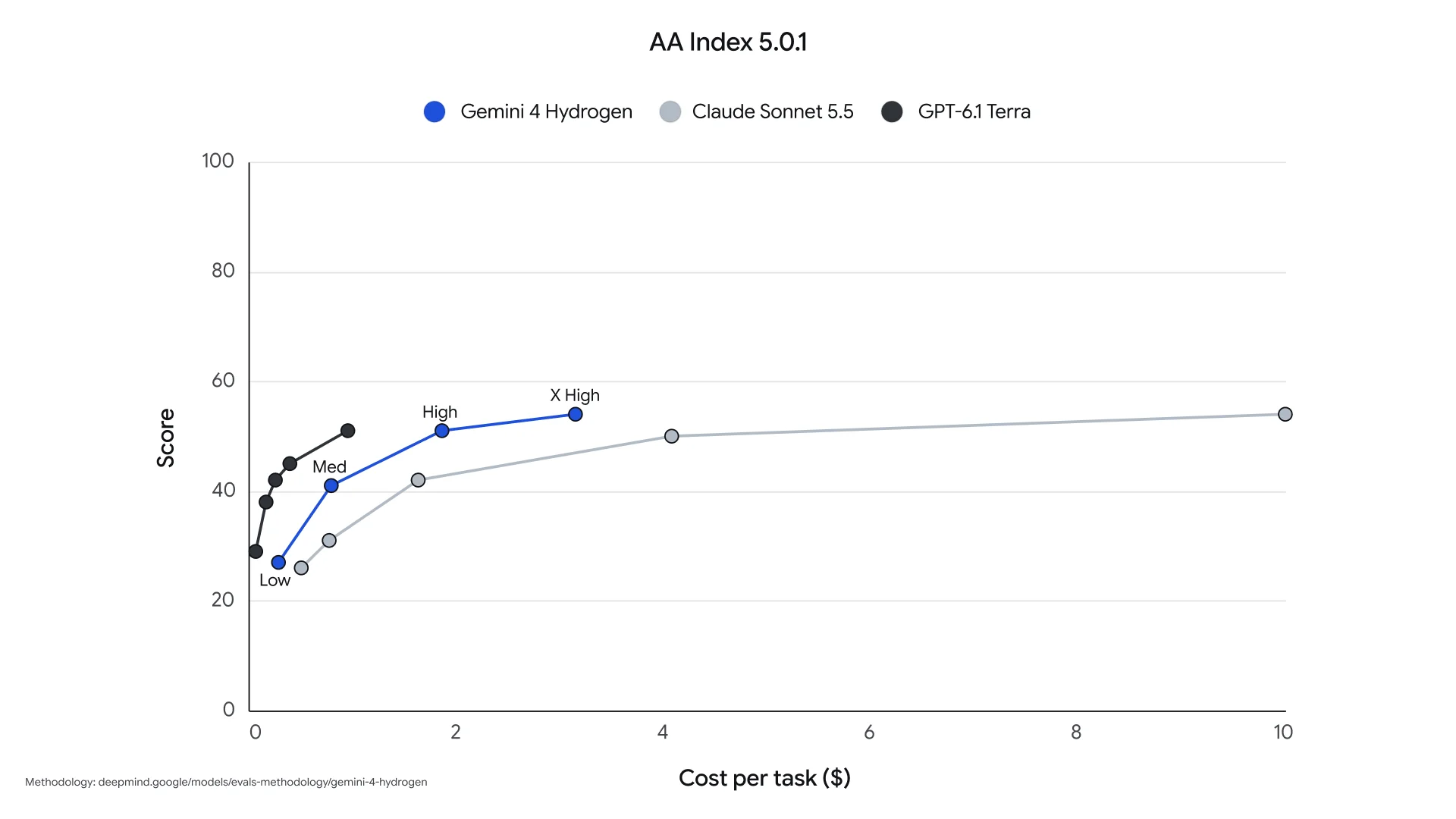
Gemini 4 Hydrogen exposes four thinking levels (low, medium, default high and xhigh) across a 1M-token input and 1M-token output window so engineers can trade latency against deeper multi-turn tool verification. On the Artificial Analysis Intelligence Index 5.0.1, it scores 51 at default high thinking (ahead of Gemini 4 Argon at 50) and climbs to 54 at xhigh.
Artificial Analysis Intelligence Index 5.0.1 places Gemini 4 Hydrogen at 51 on default high thinking and 54 on xhigh.Image: Google
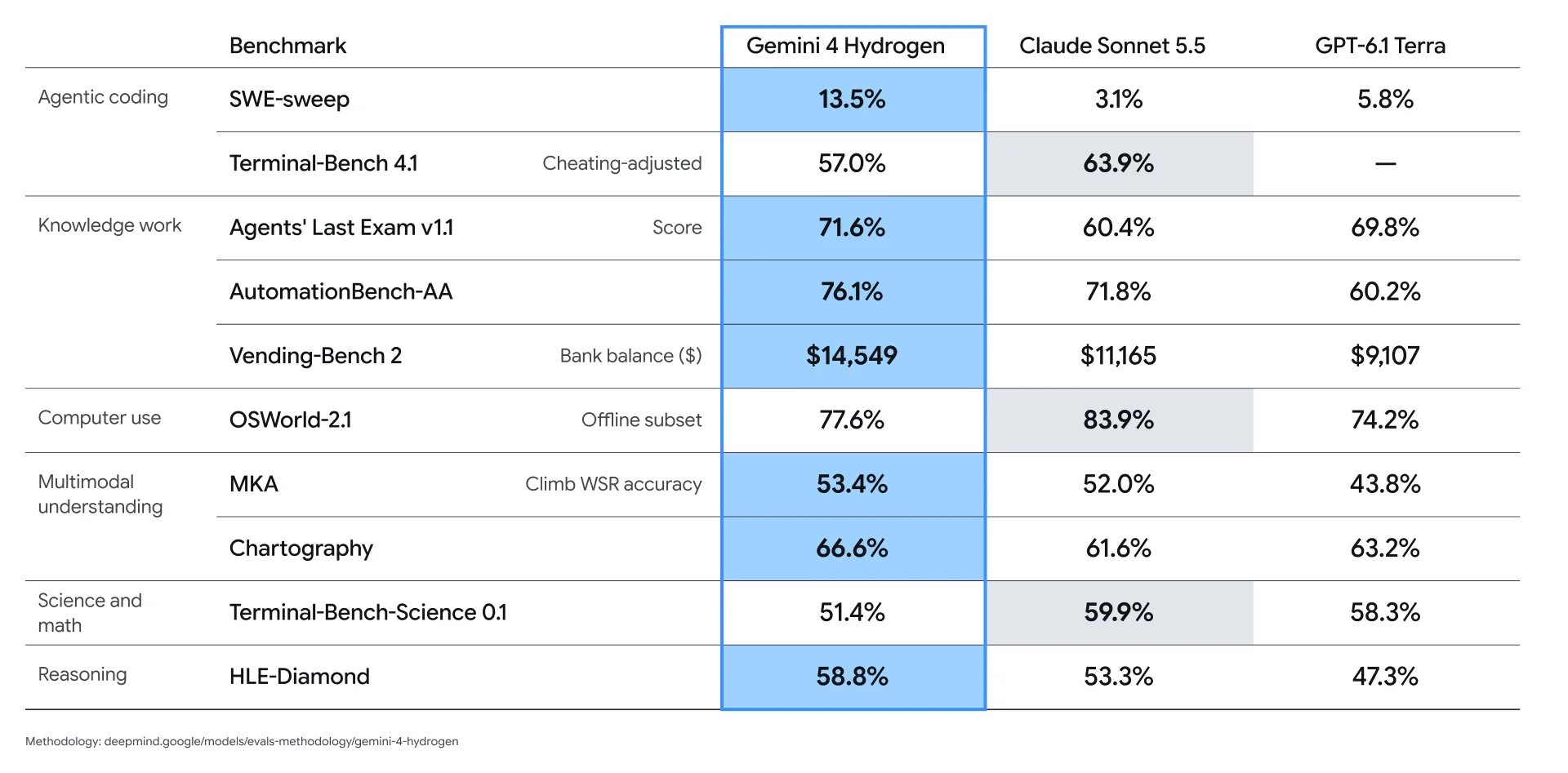
On external harnesses, Hydrogen leads Vals Tax Agent Bench at 52.3%, ties first on Vals Legal Research Bench at 55.8%, scores 54.3% on CursorBench (up from 39.6% for Gemini 3.8 Flash) and reaches 38.2% on FrontierCode 2.0 inside Devin Desktop and CLI.
Google’s scoreboard compares Gemini 4 Hydrogen with Claude Sonnet 5.5 and GPT-6.1 Terra across coding and agentic benchmarks.Image: Google
Inside Google Antigravity, a new Orchestrator switches dynamically between Carbon for architecture planning and Hydrogen for iterative implementation within one session.
Key numbers
Paid API pricing: flat $1.50 per million input tokens and $7.50 per million output tokens (including thinking tokens), plus $0.075 per million implicitly cached tokens and 5,000 free monthly Google Search grounding requests.
Antigravity Orchestrator efficiency: matches near-Carbon task completion on Terminal-Bench 4.0 while consuming 24% less quota and finishing 19% faster.
Agentic safety audits: cuts overreach by up to 81%, under-service by up to 79% and shortcutting by 12 times versus 3.8 Flash, with 96.7% honesty and 99.9% chain-of-thought legibility across more than 200k turns.
Google has not announced open model weights, and explicit context caching is unsupported on gemini-4-hydrogen.
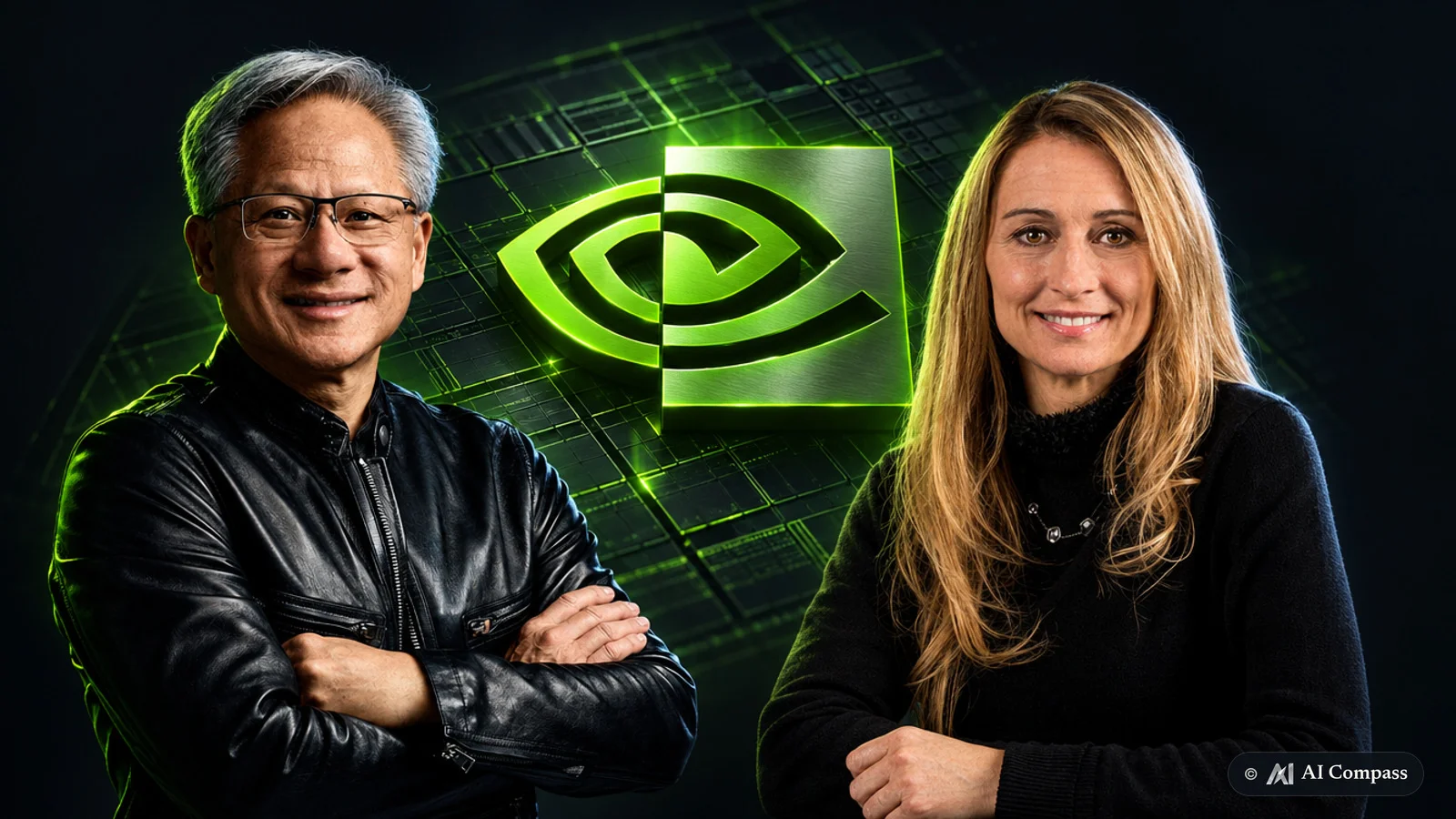
Effective 12 November 2026, NVIDIA co-founder Jensen Huang stepped down as president, chief executive and board director after 33 years, while Harvey C. Jones became the company’s first-ever board chair.
NVIDIA’s Board of Directors announced on 12 November 2026 that co-founder Jensen Huang has resigned as President, Chief Executive Officer and member of the Board, effective immediately, ending a 33-year tenure leading the company he co-founded in 1993. Executive Vice President and Chief Financial Officer Colette Kress has assumed the role of Interim Chief Executive Officer while retaining her EVP and CFO responsibilities until a permanent successor is appointed.
Governance split, CEO search and fiscal calendar
To oversee the transition, NVIDIA’s board initiated a formal succession search covering both internal and external candidates and appointed longtime director Harvey C. Jones as the first Chair of the Board in NVIDIA’s corporate history. Jones brings more than 30 years of semiconductor executive and venture investment experience, having previously served as CEO and Executive Chairman of electronic design automation supplier Synopsys.
Kress joined NVIDIA in September 2013 after nearly 25 years in senior finance roles across technology firms including Microsoft and Cisco, overseeing capital allocation through NVIDIA’s data-centre and AI infrastructure expansion, including recent launches such as GR00T 2 and Alpamayo 2 Edge. Jones stated that customer commitments, operations and the product roadmap will continue without interruption. NVIDIA kept its third-quarter fiscal 2027 financial results and earnings call on their existing schedule for 17 November 2026. NVIDIA’s announcement did not disclose a reason for Huang’s immediate departure or a target timeline for naming a permanent chief executive.
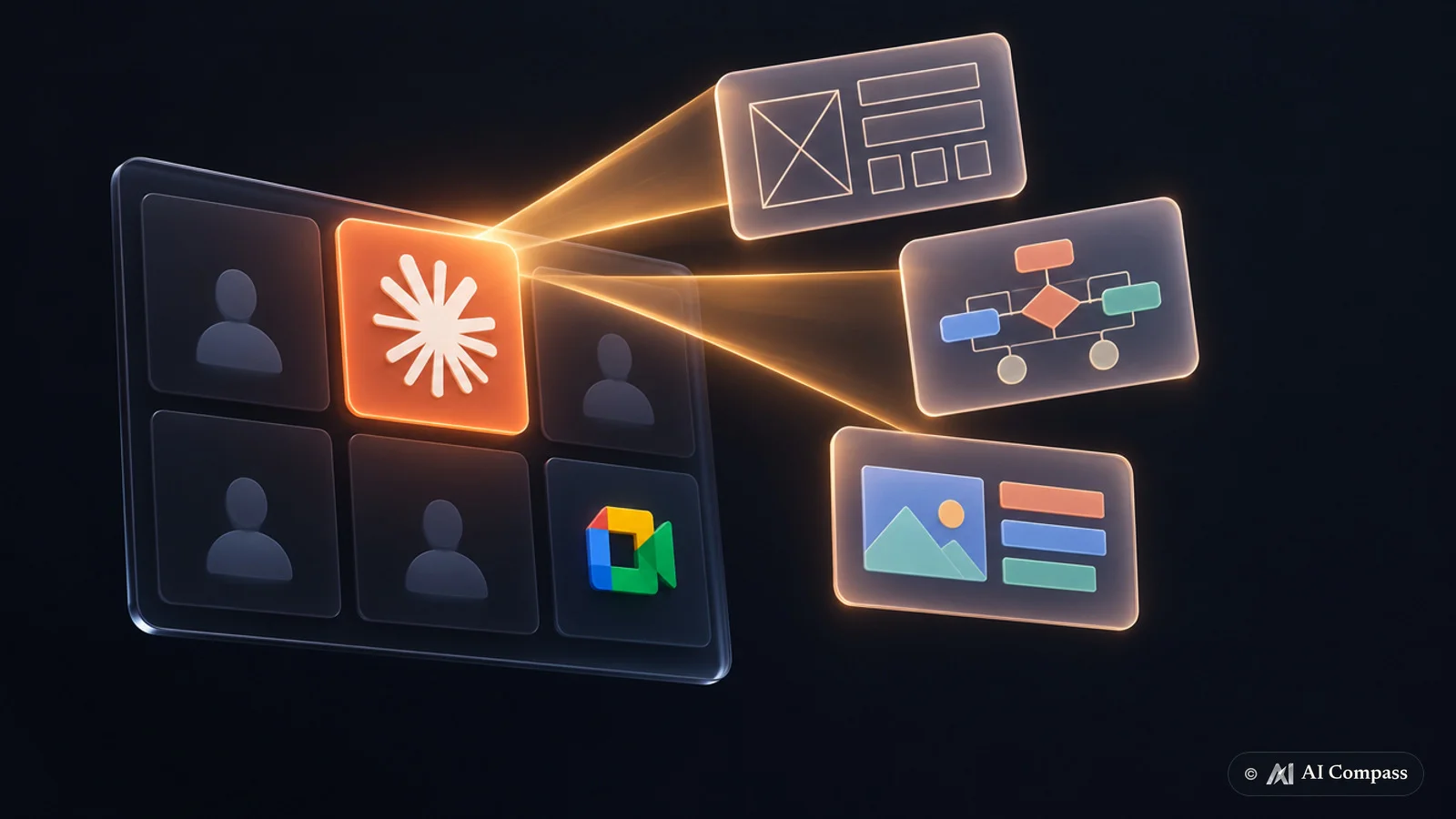
Rolling out on 12 November 2026 for Claude Team and Enterprise workspaces in web and desktop apps, Claude joins Google Meet calls as a visible participant to draft docs, slides and whiteboards live.
Anthropic began rolling out Claude Meetings in beta on 12 November 2026 for organisations on Claude Team and Enterprise plans across both the Claude web app and Claude Desktop. Announced via the official @claudeai account and documented in Anthropic’s Claude Apps release notes, the feature moves meeting assistance from post-call transcript summaries into active, synchronous artifact creation while participants are still speaking.
Visible Google Meet participation and live artifact co-editing
Team members can invite Claude directly into a live Google Meet video call, where it joins the session as a visible participant rather than recording silently in the background. During the conversation, Claude captures structured notes, answers spoken or in-call questions from attendees, and builds shared workspace outputs in real time, including Claude Docs, Claude Whiteboards and Claude Slides.
Because those artifacts update while the discussion is underway, engineering and product groups can review architecture diagrams, action tables or draft specifications together before hanging up instead of waiting for an asynchronous recap after the call ends. Anthropic has limited the initial beta to Google Meet on Team and Enterprise accounts and has not announced support timelines for Zoom or Microsoft Teams, per-minute audio quotas, or availability on individual Pro and Max subscriptions.
Built with Samsung, Gentle Monster and Warby Parker, the IPX4 smart glasses pair an ultra-wide 12 MP 3K HDR camera, open-ear speakers and up to 9 hours of battery life with hands-free Gemini voice assistance.
Google opened pre-orders on 12 November 2026 for its intelligent eyewear collections powered by Gemini, one day after rolling out Gemini Live on Apple CarPlay, in partnership with Samsung and eyewear brands Gentle Monster and Warby Parker (including optional prescription lenses ordered on partner product pages). Wearers trigger assistance hands-free with the wake phrase “Hey Gemini” or via discreet taps and swipes on the frame, while the glasses remain in local standby until activated.
Camera hardware, live translation and Guided Vision
Each frame integrates an ultra-wide 12 MP camera with real-time HDR stabilisation capable of recording straightened 3K video, paired with open-ear directional speakers and beamforming microphones. Beyond hands-free capture and live point-of-view video sharing inside Google Meet calls, Look and Ask handles visual recognition and cross-retailer price checks, Google Maps delivers turn-by-turn walking audio, and Google Translate runs spoken and visual translation across more than 70 languages while isolating a speaker’s voice in noisy environments. A Guided Vision accessibility mode reads mail and appliance displays aloud and narrates room layouts.
Battery, phone compatibility and privacy controls
The frames run up to 9 hours on a mixed-use charge, reach 60% inside their charging case in roughly 30 minutes, and carry IPX4 splash resistance. Privacy hardware includes a physical power-off switch plus inner and outer LEDs that automatically halt photo or video capture if the outer indicator light is covered, and camera visuals from Gemini sessions are excluded from Gemini History, model training and ad targeting. Use requires an 18+ US or South Korean Google account paired over Bluetooth with a Pixel 7 or newer (Android 17 September 2026+), Samsung Galaxy S or Z phone (UI 9.0+), or iPhone 13 or newer (6 GB RAM, iOS 26.6+). Google did not publish unified retail pricing or shipping dates on glasses.google.
Available on 12 November 2026 through Anthropic account teams, the private beta lets enterprises run the Managed Agents server, PostgreSQL state store and tool sandboxes inside their own cloud or on-prem network.
Anthropic launched self-hosted Claude Managed Agents in private beta on 12 November 2026, documented on Claude Platform Docs and announced by @ClaudeDevs. Whereas Anthropic’s earlier self-hosted sandboxes option kept the orchestration API on Anthropic infrastructure, and one day after Google added self-hosted sandboxes for Gemini Managed Agents, Anthropic’s new deployment mode moves the entire Managed Agents service into a customer’s own cloud account or on-premises data centre.
Control-plane architecture, PostgreSQL storage and provider routing
A self-hosted deployment comprises the cma-server binary (running the REST API and autonomous agent loop without executing shell or file tools itself), a PostgreSQL 16 or newer database persisting agents, sessions and full event history, and isolated workers launched via Docker Compose, the cma-sandboxes Helm chart, the ant beta:worker CLI or SDK workers. Because the server exposes the identical API as Anthropic’s hosted service, existing SDK code and the ant CLI connect without code rewrites, alongside a local web console wired to the customer’s identity provider and a cma-server-admin CLI for Linux (x86-64 and Arm) and Apple silicon macOS.
Administrators split trust across three separate keys (Server API key, Inference credential and per-queue Environment key) and route model calls to the Claude API by default or to Amazon Bedrock, Google-managed Claude Models on Google Cloud, Microsoft Foundry, or an internal model gateway. Enterprises must request binary download access through their Anthropic account team under the Claude Managed Agents Server licence; Anthropic has not published self-hosted licensing fees.
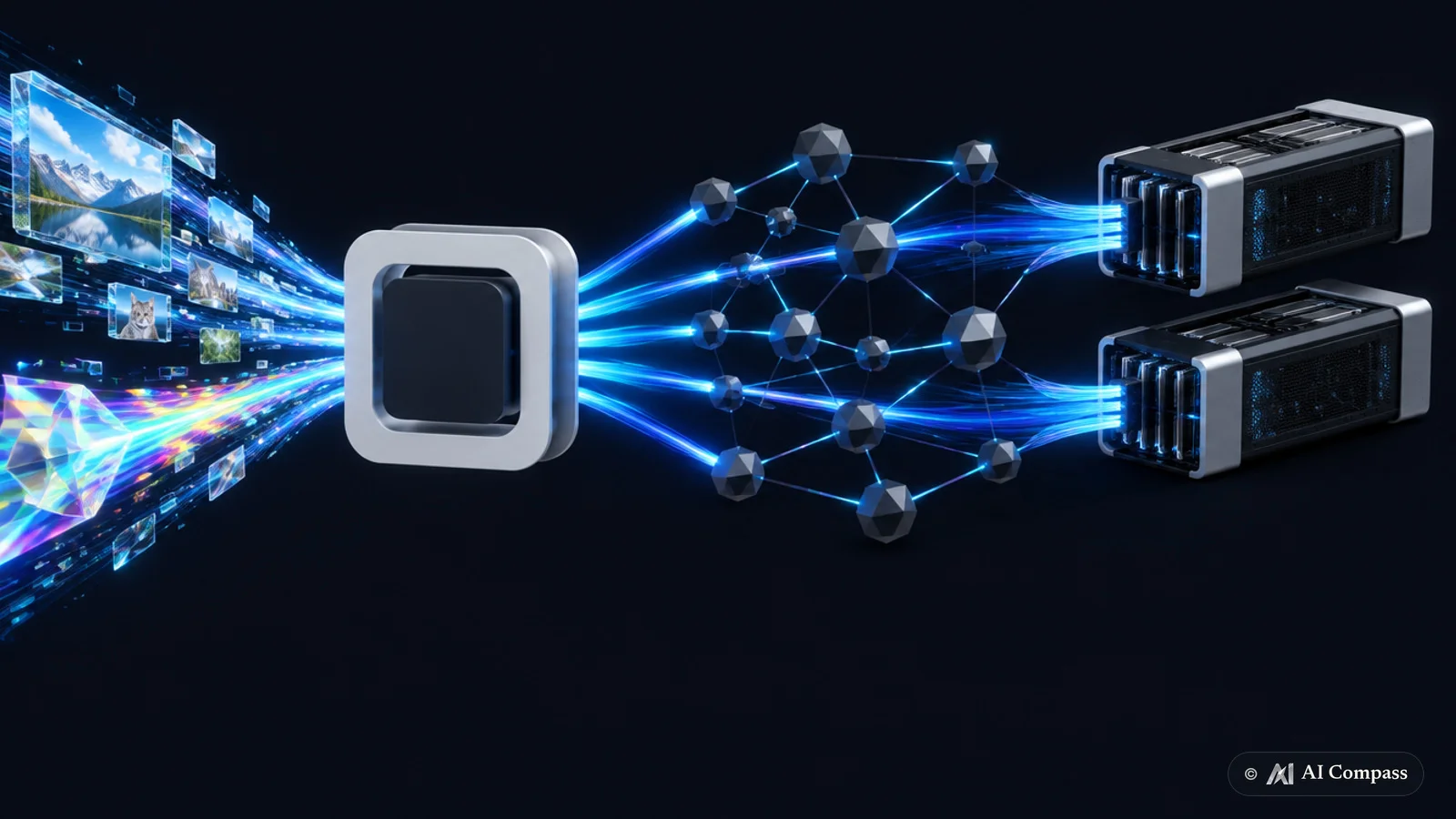
Distributed in native NVFP4 and MXFP8 checkpoints on Hugging Face, the 48-layer multimodal MoE activates 17B of 594B parameters across a 1M-token context window for local GPU clusters.
Thinking Machines Lab published the open weights for Inkling 2 Small on Hugging Face at thinkingmachines/Inkling-2-Small under an Apache 2.0 licence on 12 November 2026, fulfilling the open-weight commitment made during its 5 November Tinker preview. Built as a general-purposeimage-text-to-text model for agentic tool use, coding assistants and retrieval-augmented generation, the model accepts UTF-8 text and pixel images (optimised between 40 px and 4096 px per side) across a context window of up to 1M tokens.
Sparse MoE architecture, native NVFP4 weights and GPU footprints
Inkling 2 Small uses a 48-layerdecoder-only transformer with hybrid local and global attention, a vision transformer encoder projecting images into a shared hidden space, and a sparse Mixture-of-Experts backbone routing each token to 8 of 384 experts (17B active parameters out of 594B total; Hugging Face lists 383B packed tensor parameters on the repo badge). Because pretraining, midtraining and post-training all ran natively in NVFP4, Thinking Machines Lab recommends the NVFP4 checkpoint, which fits in 500 GB of aggregate VRAM (such as 2 NVIDIA B300 GPUs or 4 H200 GPUs).
An alternative MXFP8 checkpoint requires at least 800 GB of VRAM (4 B300 or 8 H200 GPUs) for a 1 to 2 percentage point evaluation delta that the lab notes is negligible in practice. Local serving recipes ship for SGLang, vLLM, TokenSpeed, Unsloth, Hugging Face Transformers and Docker Model Runner, alongside fine-tuning via the Tinker Cookbook with tml-renderers or Snowflake Cortex Training.
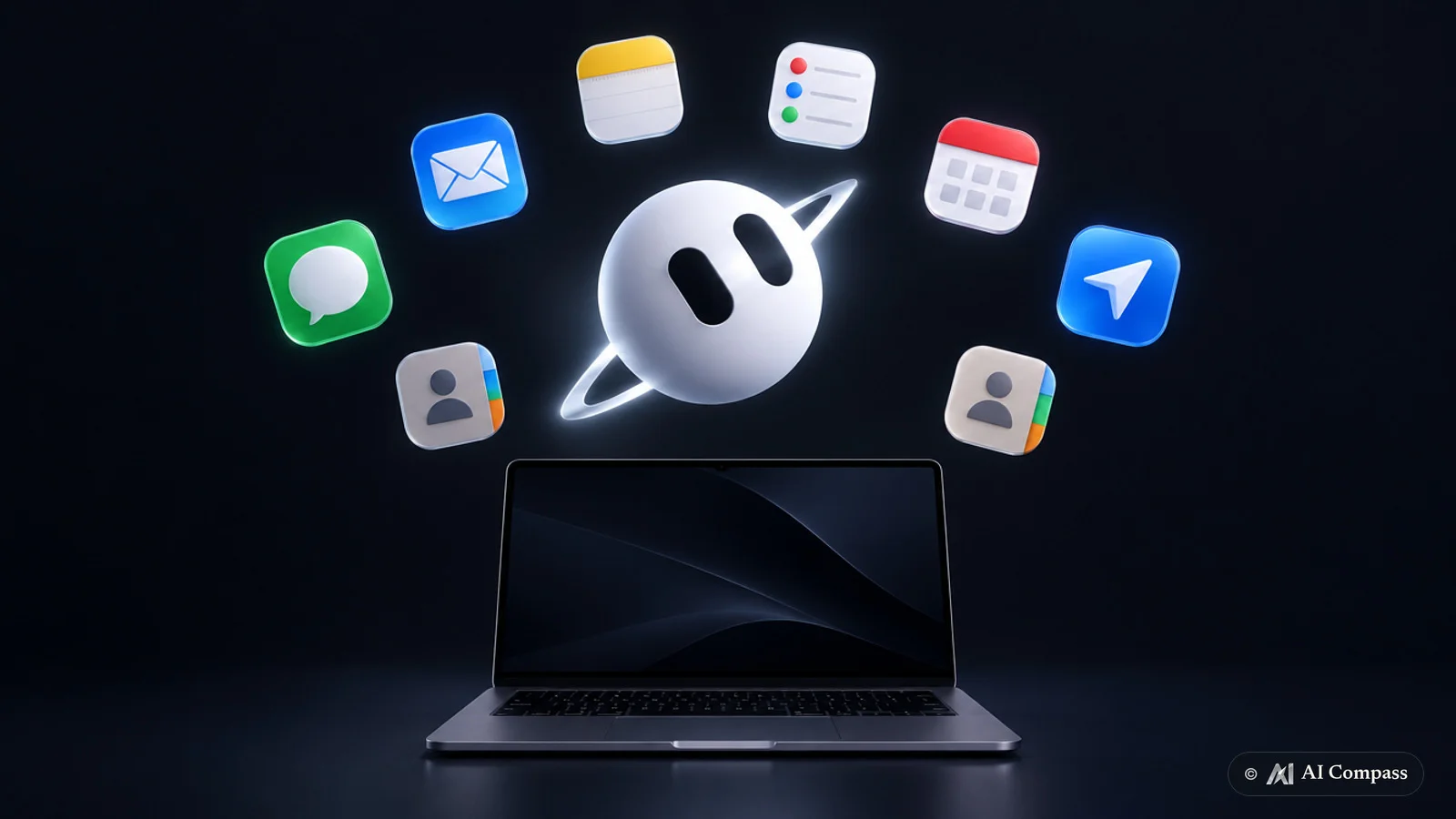
Grok Bot on macOS reads and acts directly across Apple Messages, Mail, Notes, Reminders, Calendar, Location and Contacts, extending SpaceXSI’s assistant onto local Mac workflows.
SpaceXSI expanded Grok Bot on Mac on 12 November 2026 with direct integrations across seven built-in Apple applications and system services: Messages, Mail, Notes, Reminders, Calendar, Location and Contacts. Announced via the product’s official @bot account on X, the macOS update arrives one day after SpaceXSI launched Grok Bot 1.0 collaborative AI teammates for Slack, Microsoft Teams and live workplace meetings.
Desktop personal-information hooks beyond October mobile actions
SpaceXSI previously brought native device actions to iOS and Android on 22 October 2026 with Grok Bot phone app integrations focused on Calendar, Reminders and Contacts. Extending those hooks onto macOS adds first-party Apple Messages, Mail, Notes and Location access on the desktop, allowing Mac users to coordinate schedules, inspect correspondence, capture notes and reference contact or location context from one assistant workspace without manually copying text between Apple apps.
Pairing local Apple personal-information access on macOS with shared Slack and Microsoft Teams channels bridges personal task management and enterprise chat inside the same Grok Bot product line. Consistent with its 11 November 1.0 rollout, SpaceXSI announced the macOS integrations solely on X and did not publish companion documentation specifying minimum macOS version requirements, per-app macOS TCC permission prompts, local versus cloud indexing boundaries, or subscription tier restrictions.
The upgraded Devin Teams tier bundles Devin Desktop for every member, two concurrent free SWE-2 sessions per user, SAML and OIDC single sign-on, three spend tiers and a HIPAA BAA.
Cognition overhauled its Devin Teams plan on 12 November 2026, following Devin Review 2.0, by removing separate paid seat charges for Devin Desktop so every member of a Teams workspace can run the desktop environment at no extra per-seat fee. Alongside the desktop change, a new Free mode gives every Teams user two concurrent free coding sessions powered by Cognition’s in-houseSWE-2 model, with free SWE-2 access in Devin Desktop and the Devin CLI also becoming a permanent fixture across Teams, Pro and Max plans.
Admin identity, three-tier cost caps and self-serve HIPAA BAAs
Workspace administrators gain SAML and OIDC single sign-on across Okta, Microsoft Entra ID and other identity providers, with an option to disable password and email login once SSO is active. New cost controls let admins assign per-user spend caps across up to three group tiers and choose whether over-limit requests wait for manual approval or auto-approve up to a preset ceiling, while Devin Coach reviews prompts before submission and recommends lighter execution modes for small edits.
Healthcare startups can now request a standard Business Associate Agreement (BAA) directly from product Settings on the Teams tier without negotiating a custom enterprise contract, and eligible early-stage companies can apply to Cognition’s startup programme for up to $65k in credits. As part of the restructuring, Cognition is retiring quota seats on Teams in 30 days and lowering the maximum Teams workspace cap from 200 seats to 100 seats.
ElevenLabs launched an enterprise Marketplace showcasing vertical voice and conversational AI applications (including Salesforce Agentforce Voice, NiCE CXone, Twilio, IBM watsonx Orchestrate, Podium and Assort Health) alongside a formal Partner Program spanning more than 550 partners in 44 countries and 1,100 certified deployment engineers across 350 organisations, extending its 11 November ElevenAI rollout. The programme pairs Forward Deployed Engineers with integrators without competing for services revenue.
Runway rolled out native 3D asset support in its creative suite on 12 November 2026, following Sightline earlier in the week. Users can generate detailed 3D models from text prompts or still images via Tripo H3.1 or upload their own 3D meshes, rotate the asset to pick exact camera angles as visual references for downstream image or video generation, and export generated models into external 3D pipelines.
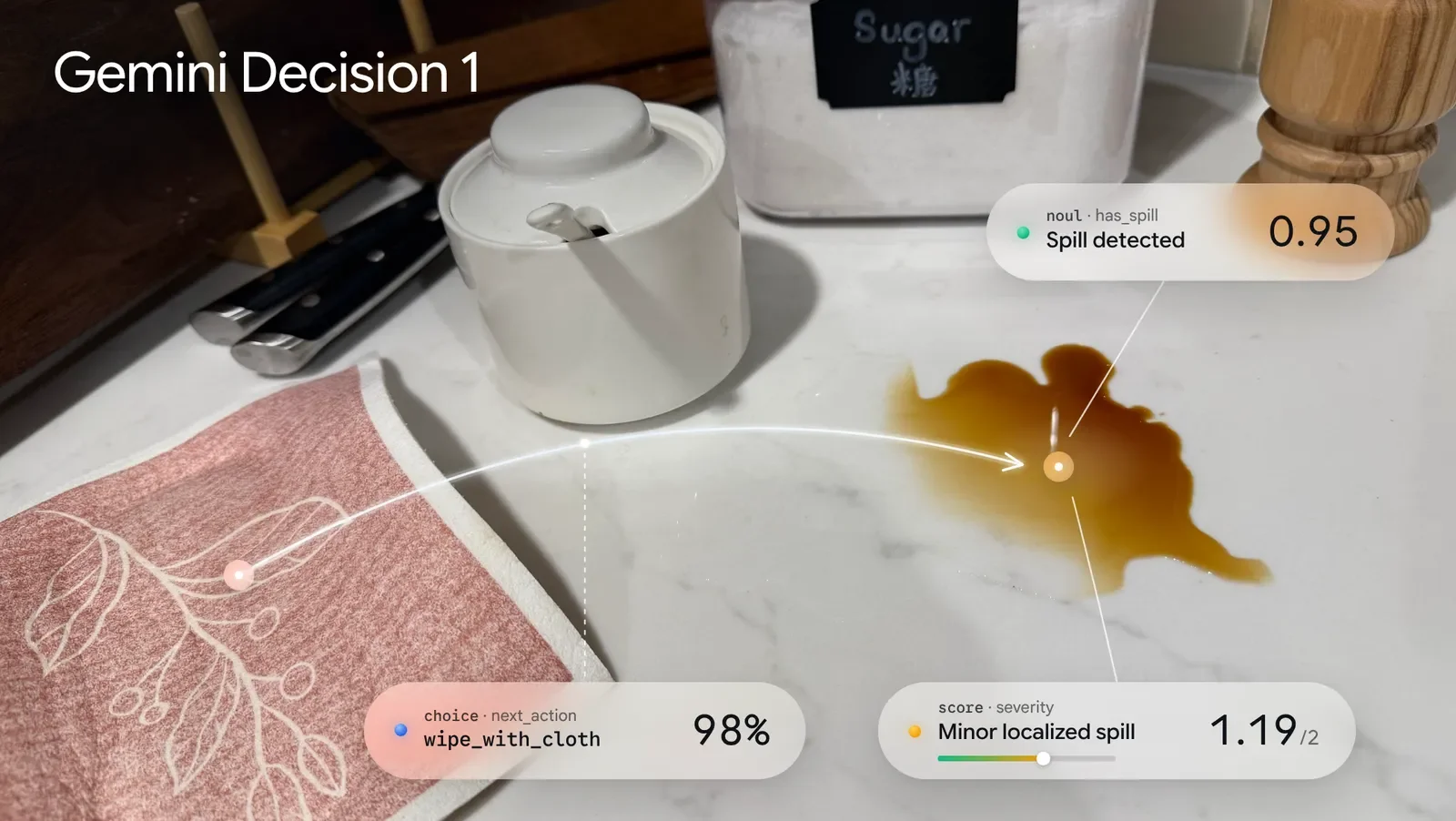
Perplexity released open-weightpplx-decider-v1.3 (adapted from Qwen3.8-27B) and KL-distilledpplx-decider-flash-v1.3 (on Qwen3.5-4B) under an Apache licence on 12 November 2026 across Hugging Face, OpenRouter and the Perplexity Decisions API, one day after Google’s Gemini Decisions API. Alongside single-pass Yes/No, multiple-choice and ordered-score probabilities with isolated-question bidirectional attention, v1.3 adds locate, an unmerged LoRA span head returning exact start and end character offsets for NER, PII and extractive QA.
OpenAI introduced two early-access defensive security products during its Cyber at the Frontier event on 12 November 2026, building on GPT-6 Cyber: Daybreak Red Team deploys coordinated agents inside isolated environments with Guardian scope controls to probe web applications, validate scanner or bug-bounty reports and re-test fixes, while Daybreak Defense Factory traces confirmed findings through source repositories with Codex to draft reviewable code patches.
OpenRouter launched beta localisation on 12 November 2026 across Simplified Chinese, Spanish, Brazilian Portuguese, German, French, Japanese and Korean alongside English, accessible from the account menu or locale paths such as openrouter.ai/ja. To keep 16,918 React UI strings current as pages ship daily (including the 11 November Extractions API), a daily Git pipeline translates fingerprinted diffs with GPT-6.1 Sol, runs ICU/glossary code checks plus a verifier retry loop, and supports reader select-to-report fixes.