Live on QwenCloud with OpenAI- and Anthropic-compatible APIs alongside Qwen Studio, QwenWork and Qoder, the 1M-context multimodal model activates 71B parameters per token.
Alibaba’s Qwen released flagship Qwen4-Max on 16 November 2026 across QwenCloud, Qwen Studio, QwenWork and Qoder, following its 10 November Qwen4-Max preview on Alibaba Token Plan. Built on the new Qwen4 sparse Mixture-of-Experts architecture, the checkpoint combines 2.4 trillion backbone parameters, 71 billion active parameters per token and 328 billion N-gram Embedding parameters with native image and video understanding across a 1-million-token context window.
Gated DeltaNet, Qwen Sparse Attention and QwenCloud API rates
Every Qwen Sparse Attention layer pairs with three Gated DeltaNet layers that compress sequence history into fixed-size states while a micro-block indexer selects relevant long-context spans. Four parallel Gated Residual branches with dynamic read-write gates and second-layerN-gram Embeddings kept the 2.4T pre-training run free of loss spikes, lowering bits per byte by 5% to 13% over Qwen3.8-Max-Base with 25% fewer active parameters.
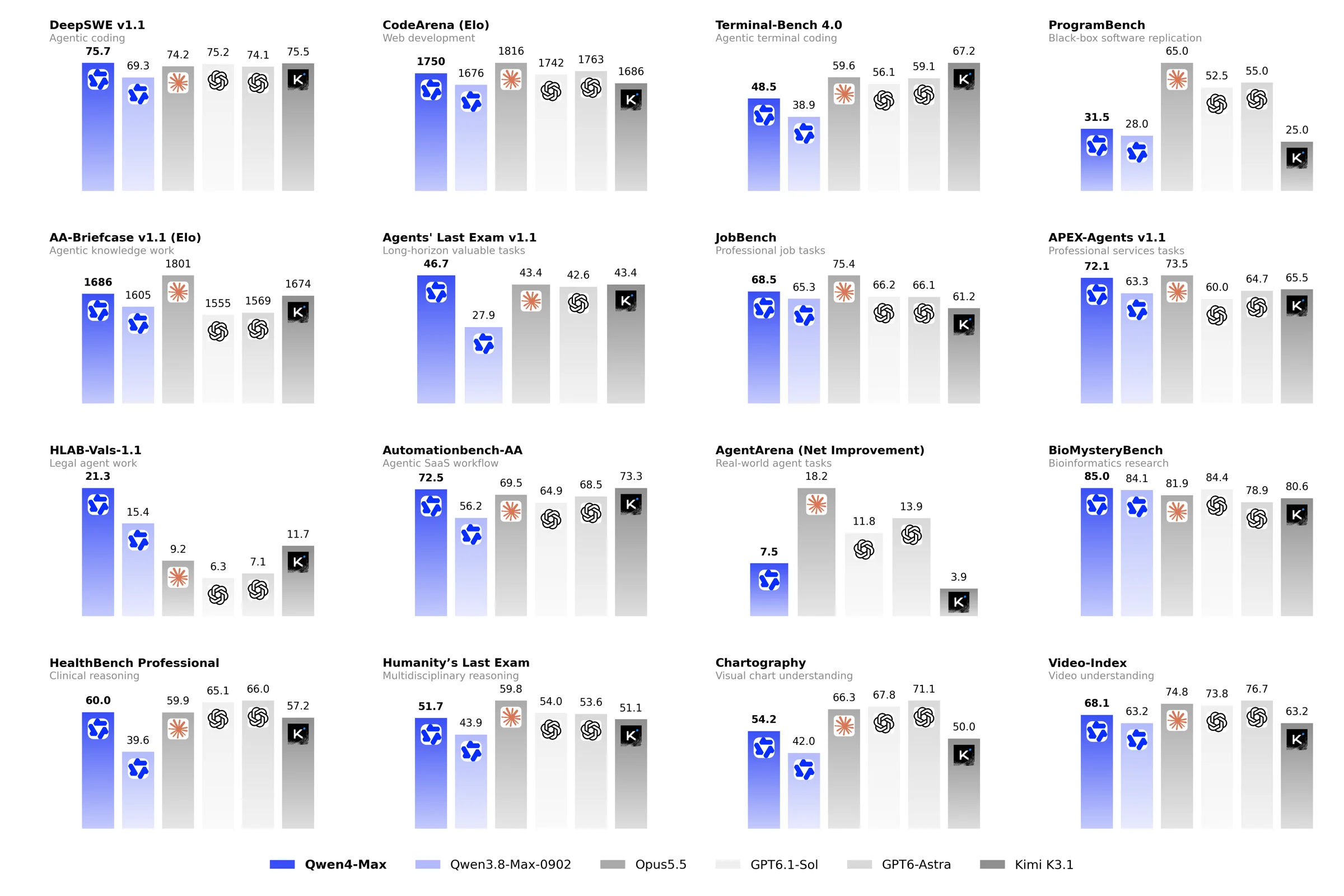
Qwen4-Max beats Qwen3.8-Max across all 16 coding, work and multimodal suites, scoring 75.7 on DeepSWE v1.1 and 1750 on CodeArena WebDev.Image: Qwen
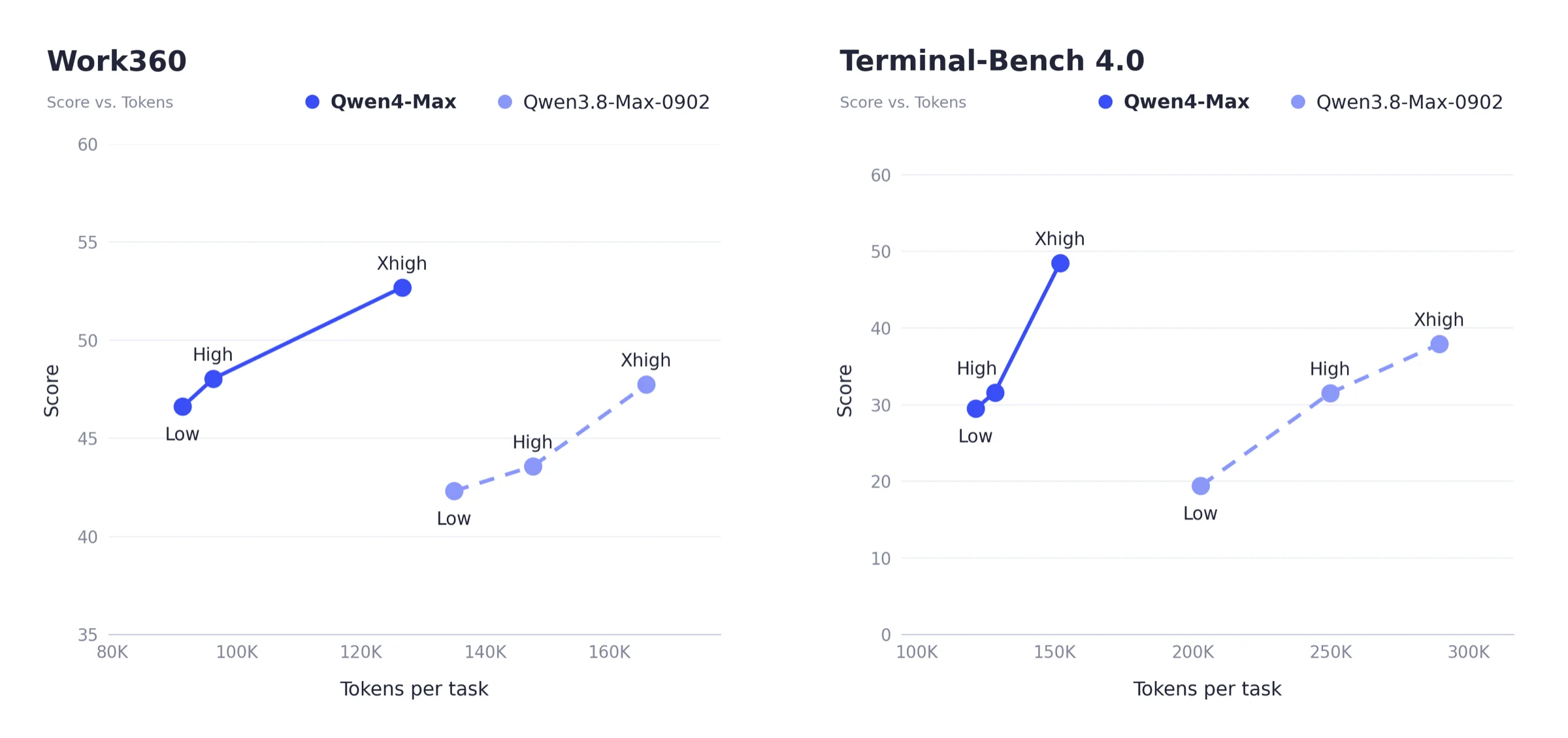
On QwenCloud, Qwen4-Max supports prefix completion, function calling and structured outputs over OpenAI- and Anthropic-compatible endpoints at $1.5 per million input tokens, $4.5 per million output tokens and $0.075 per million implicit or explicit cache reads (down 70% on implicit cache versus Qwen3.8-Max). On Work360 across 721 specialised fields, average task spend fell 62% from $4.43 to $1.67, while Arena placed Qwen4-Max 14th overall (first among Chinese models) on Agent Arena across 14.7k sessions. Qwen stated that open weights for smaller Qwen4 models are planned, without announcing a release date.
On Work360 and Terminal-Bench 4.0, Qwen4-Max lifts accuracy while cutting tokens by 24% to 35% and 48% to 49% at High and Xhigh effort.Image: Qwen
Available through the Perplexity API and API Console with existing Search and Agent API keys, billing $1 per 1,000 search runs or $1 per 1,000 fetched page URLs.
Perplexity introduced the Perplexity Monitor API on 17 November 2026 across the Perplexity API and API Console, sharing the same API key used for its Search, Context and Agent APIs. Priced at $1 per 1,000 succeeded search runs ($0.001 per run) or $1 per 1,000 counted URLs fetched in page runs ($0.001 per URL), the service replaces custom polling scripts with managed web topic and page-diff watchers.
Monitors run on fixed intervals such as every 15 minutes, hourly, daily or weekly, on custom cron expressions or on demand, and support two target modes: Search monitors (queries up to 1,000 characters, up to 20 results and optional 20-host include or exclude domain filters) and Page monitors tracking text snapshots across up to 10 public URLs. Developers can attach and edit a plain-language goal at any time without recreating the monitor.
Before firing an event, Perplexity Decider grades Search candidates against four configurable thresholds (relevance, source legitimacy, novelty and time-window freshness) and scores Page unified diffs (truncated cleanly at 24 KiB with full added and removed line counts) for goal meaningfulness, returning a 0-to-1 confidence score. Updates arrive over v1-signed webhooks (monitor.changes.detected, monitor.run.completed and monitor.paused) with seven automatic backoff retries spanning roughly 17.6 hours on timeouts, 429s or 5xx responses. Organisations enforcing zero data retention cannot create or run monitors.
Rolling out globally on the web on 16 November 2026 at notebook.google.com for users aged 18+ and Google Workspace accounts, turning notebook sources into downloadable apps.
Google launched interactive site generation in Gemini Notebook (notebook.google.com) on 16 November 2026, rolling out globally on the web for personal Google accounts and Google Workspace subscribers aged 18 and older, with mobile app support planned. Users who hold edit access to an existing or newly created notebook can type make me a site or make a site in the Chat panel alongside a plain-language description to compile uploaded notes, research papers and documents into an interactive web artifact inside the Studio panel.
Stateful Studio artifacts, isolated viewer inputs and local file downloads
Generation runs asynchronously in the background so users can keep querying or editing their notebook while Gemini Notebook builds the interface, joining Workspace integrations such as Google Wallet and Plaid in Gemini Personal Intelligence. Google highlighted three primary patterns: visual study explainers such as interactive periodic tables and historical timelines, interactive data dashboards for metrics such as quarterly sales, and project management trackers with tasks and deadlines.
Once generated in the Studio panel, sites can be launched full-screen via Open in new tab or exported locally via Download to share as a standalone file. Interactive controls including checkboxes, logged notes and text fields automatically persist and reload across sessions for each user; on shared sites, state is strictly isolated per viewer so neither collaborators nor the notebook owner see other users’ inputs. Google noted that Gemini Notebook usage limits apply to site creation.
Live across Tencent Cloud TokenHub, WorkBuddy, Yuanbao and OpenRouter with a 1M context window, offering 50% promotional API discounts until 30 November 2026.
Tencent Hunyuan released Hy4 flash on 16 November 2026 across Tencent Cloud TokenHub, OpenRouter (tencent/hy4-flash), WorkBuddy, Yuanbao, WeCom, QQ, ima and Marvis, following its flagship multimodal Hy4 launch. The natively multimodal Mixture-of-Experts checkpoint pairs 224 billion total parameters (including 64 billion Engram parameters) with 12 billion active parameters per token across a 1-million-token context window.
LatentMoE KV-cache compression, 150 tok/s serving and API pricing
Pre-training combines hybrid attention, LatentMoE and Engram lookups to shrink KV-cache memory to one-sixth of Hy4 and one-twenty-fourth of Hy3, while self-distillation from Hy4 and reinforcement learning trim average end-to-end output tokens by 50%. At inference, megakernels, 4-bit quantisation and DFly push decoding throughput above 150 tokens per second.
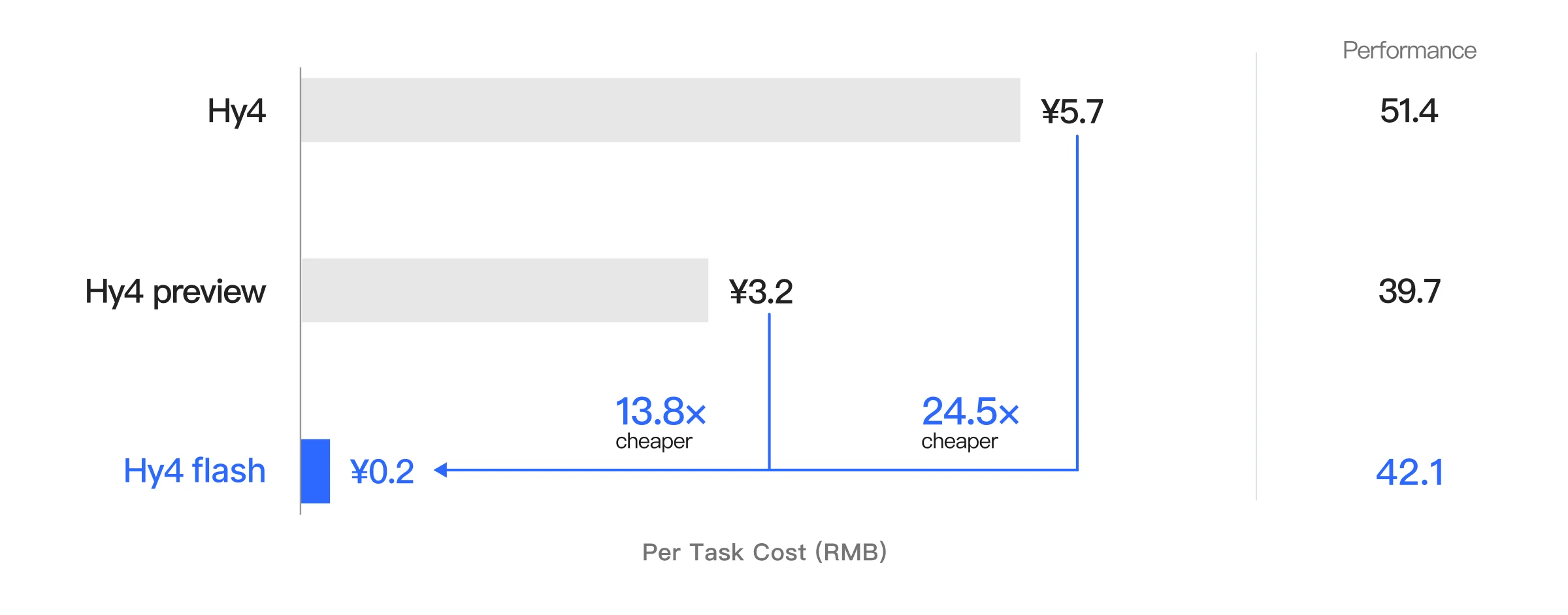
On WorkIndex, Hy4 flash scores 42.1 above Hy4 preview (39.7) at 0.2 RMB per task, 24.5 times cheaper than full Hy4 (5.7 RMB).Image: Tencent
Standard API rates per million tokens are $0.070 uncached input, $0.281 output and $0.003 cached input, down from $0.834 input, $2.501 output and $0.042 cached on Hy4; through 30 November 2026, Tencent Cloud TokenHub and OpenRouter bill 50% off ($0.035 input, $0.1405 output and $0.0015 cache read), and WorkBuddy usage is free. On Tencent’s eight-set WorkIndex benchmark, Hy4 flash edges past Hy4 preview at one-twentieth the per-task cost of Hy4 and one-eighth that of DeepSeek-V4.1-Flash-1017 (Max peak pricing). Tencent stated that it plans to release Hy4 flash as an open-weight model at a later date.
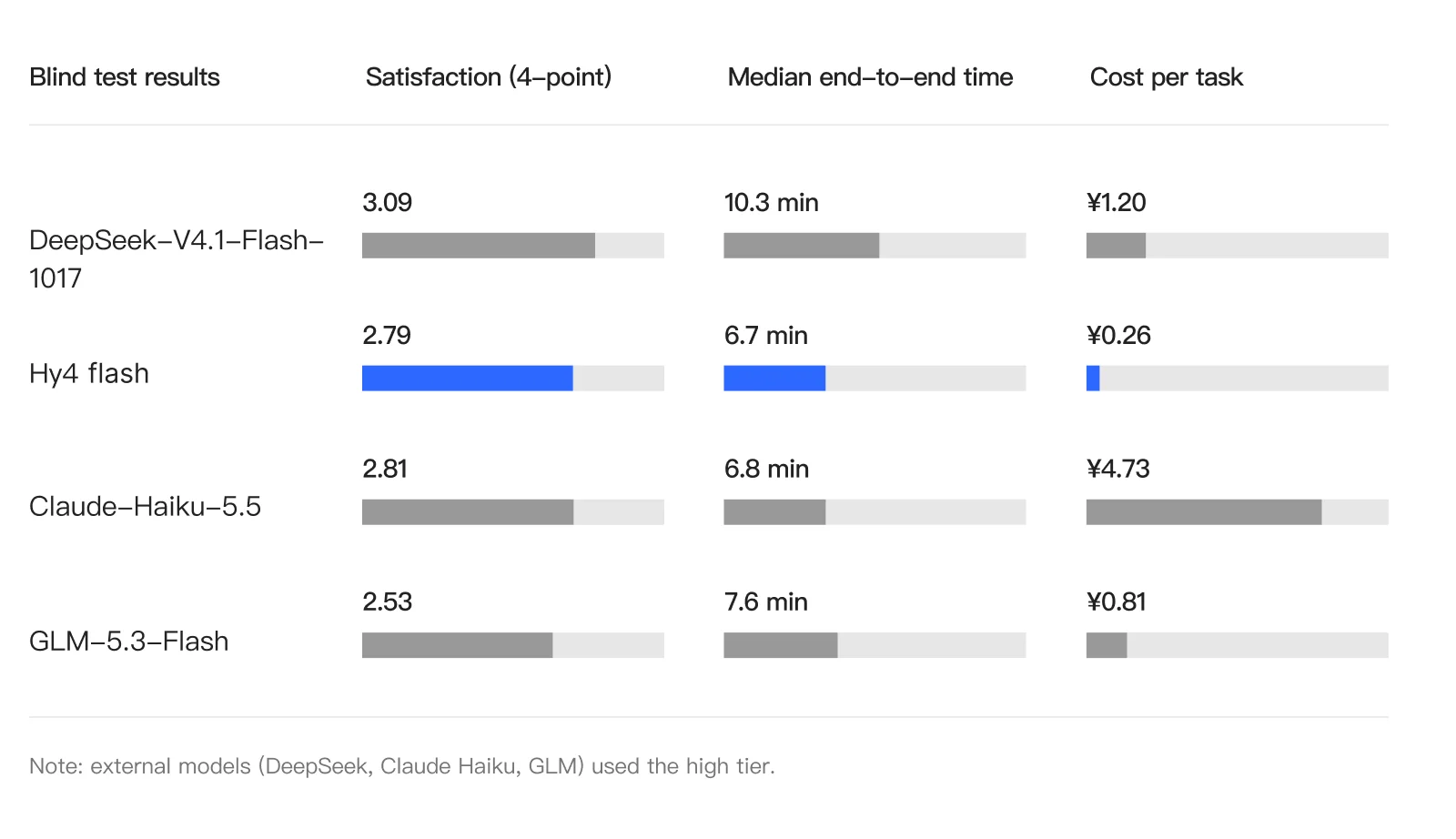
Across 259 blind tasks with 85 WorkBuddy users, Hy4 flash matched Claude Haiku 5.5 satisfaction (2.79 vs 2.81) at 0.26 vs 4.73 RMB a task.Image: Tencent
Live on 16 November 2026 across 160 open-weight chat models from 38 labs using existing Hugging Face tokens, OpenAI and Anthropic SDKs and zero platform markup.
Hugging Face and OpenRouter announced a partnership on 16 November 2026 replacing Hugging Face’s custom Inference Providers language-model router with OpenRouter’s live routing engine. Requests to 160 open-weight chat models from 38 labs on the Hugging Face Hub now route dynamically across more than 80 inference providers using the developer’s existing Hugging Face token, billing account and endpoint URLs without code changes.
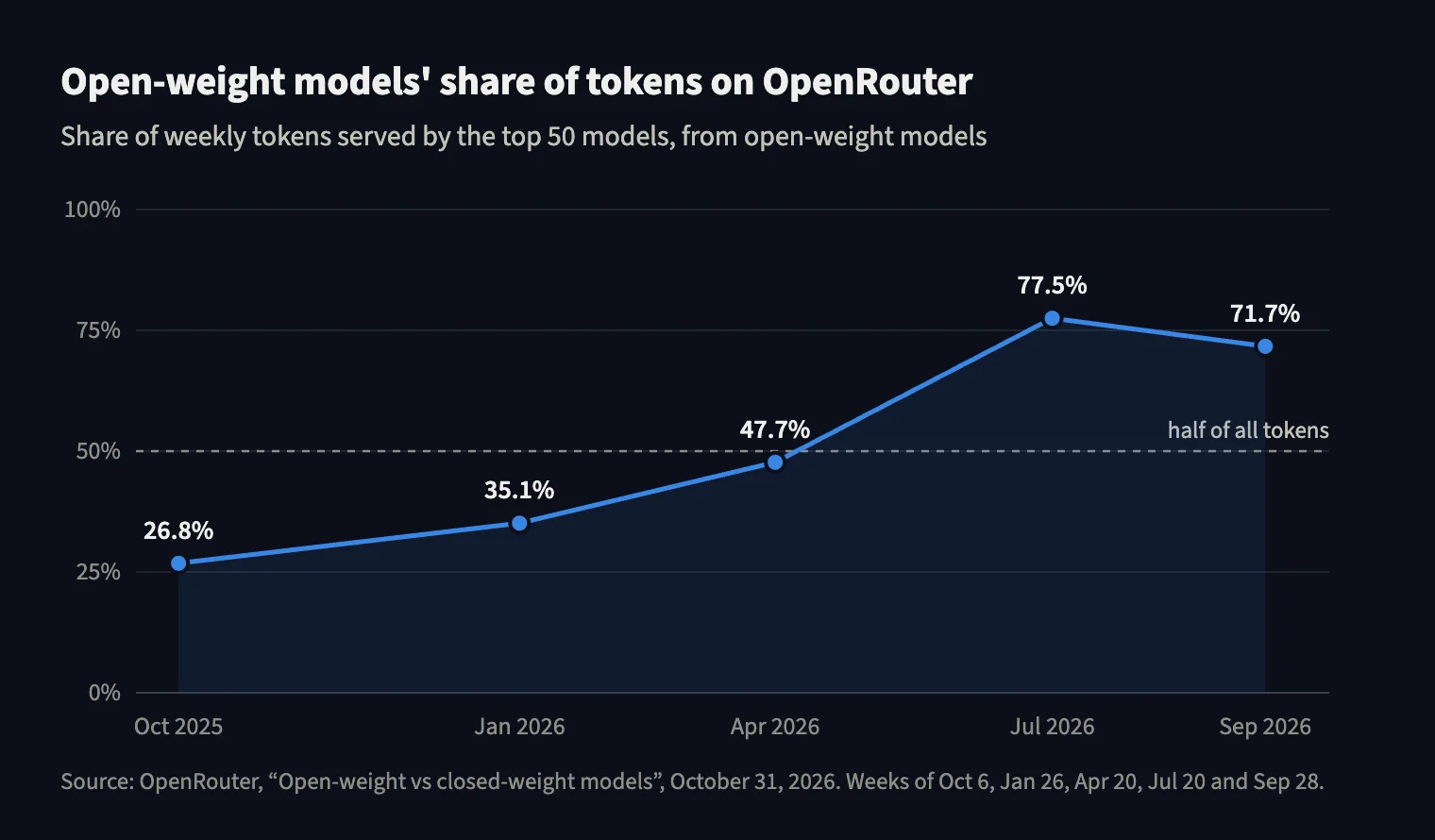
Open-weight models grew from 26.8% of weekly OpenRouter tokens in October 2025 to 71.7% in late September 2026, rising over 60-fold.Image: Hugging Face
Failover routing, X-HF-Session-Id cache stickiness and BYOK changes
The router exposes OpenAI Chat Completions, OpenAI Responses and Anthropic Messages APIs with setup guides for Claude Code, Codex, OpenCode, Pi and Hermes Agent, passing provider list prices straight to the user’s Hugging Face bill with zero markup ($2 monthly credits included on PRO and $2 per seat on Team and Enterprise). Following OpenRouter’s Auto Router rebuild, calls weigh live price, throughput and uptime and automatically retry degraded attempts on the next-best host inside the same request, cutting capacity errors by 46% and time to first token by 16.9% in OpenRouter’s measurements.
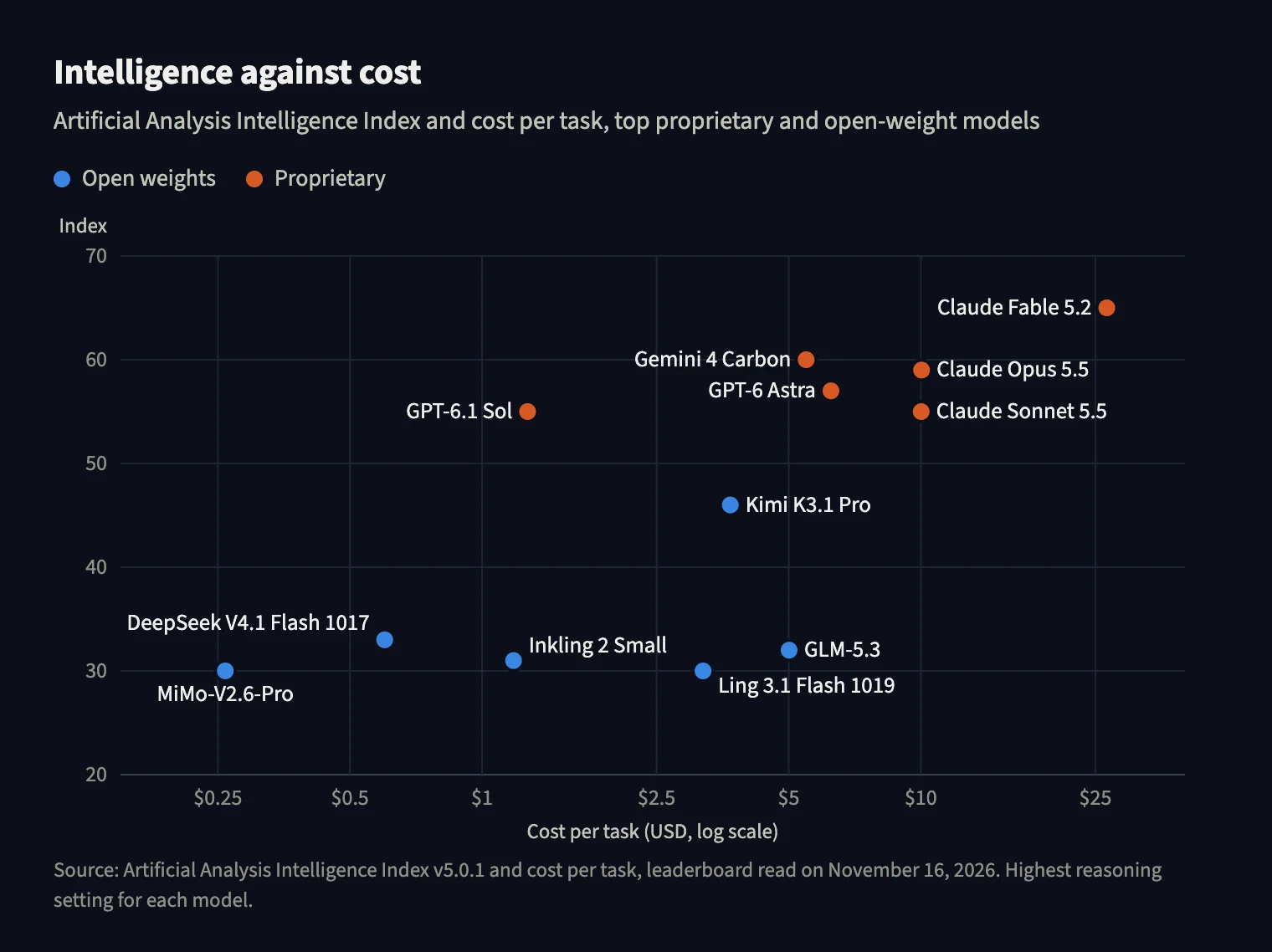
On Artificial Analysis v5.0.1 (16 November 2026), open-weight Kimi K3.1 Pro scored 46 at $3.68 vs 65 at $26.54 for Claude Fable 5.2.Image: Hugging Face
Conversations stay pinned to the provider holding their prompt cache (explicitly controllable via the X-HF-Session-Id UUID header), while Hub model pages add Providers and Metrics tabs plus OpenRouter Broadcast trace export to Hugging Face Storage Buckets. Because language-model calls now settle through Hugging Face billing via OpenRouter, bring-your-ownthird-party provider API keys no longer work for chat models, though model:provider suffixes, org-wide provider blocklists and custom keys for image, video and audio models remain unchanged.
Live on the 64k-context Liquid API at $0.02 and $0.042 per million input tokens with zero output fee, adding audio input and five structured extraction tasks.
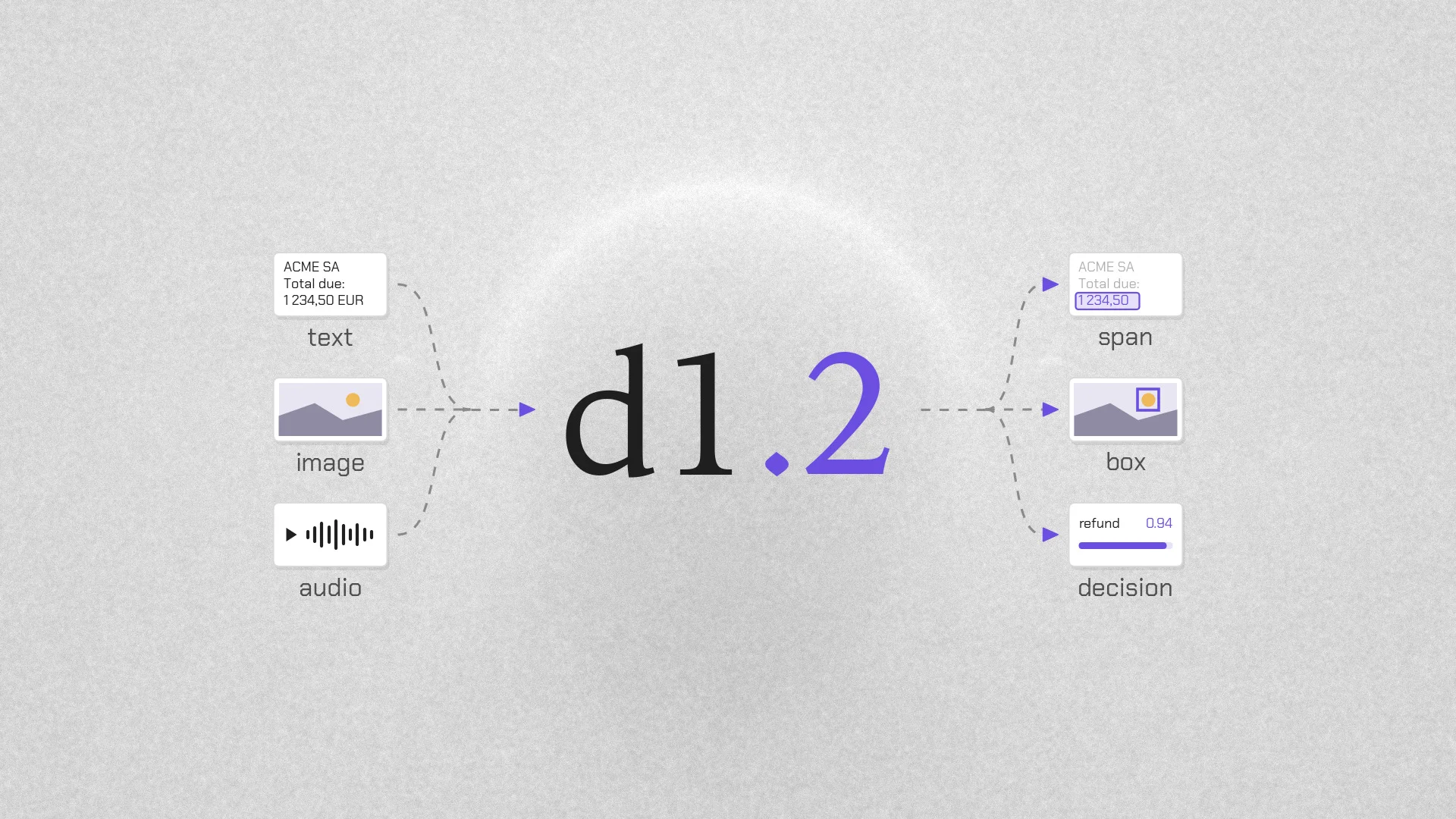
Liquid AI launched d1.2 and d1.2-ultra on 16 November 2026 on the Liquid API (console.liquid.ai), upgrading its 64k-context decision models beyond text and images to accept spoken or ambient audio while adding five structured extraction and spatial grounding task types. Following Liquid AI’s LFM3 model family, both checkpoints bill strictly for input tokens with zero output-token charge: $0.02 per million input tokens for d1.2 and $0.042 per million input tokens for d1.2-ultra, with OpenRouter and Vercel availability planned.
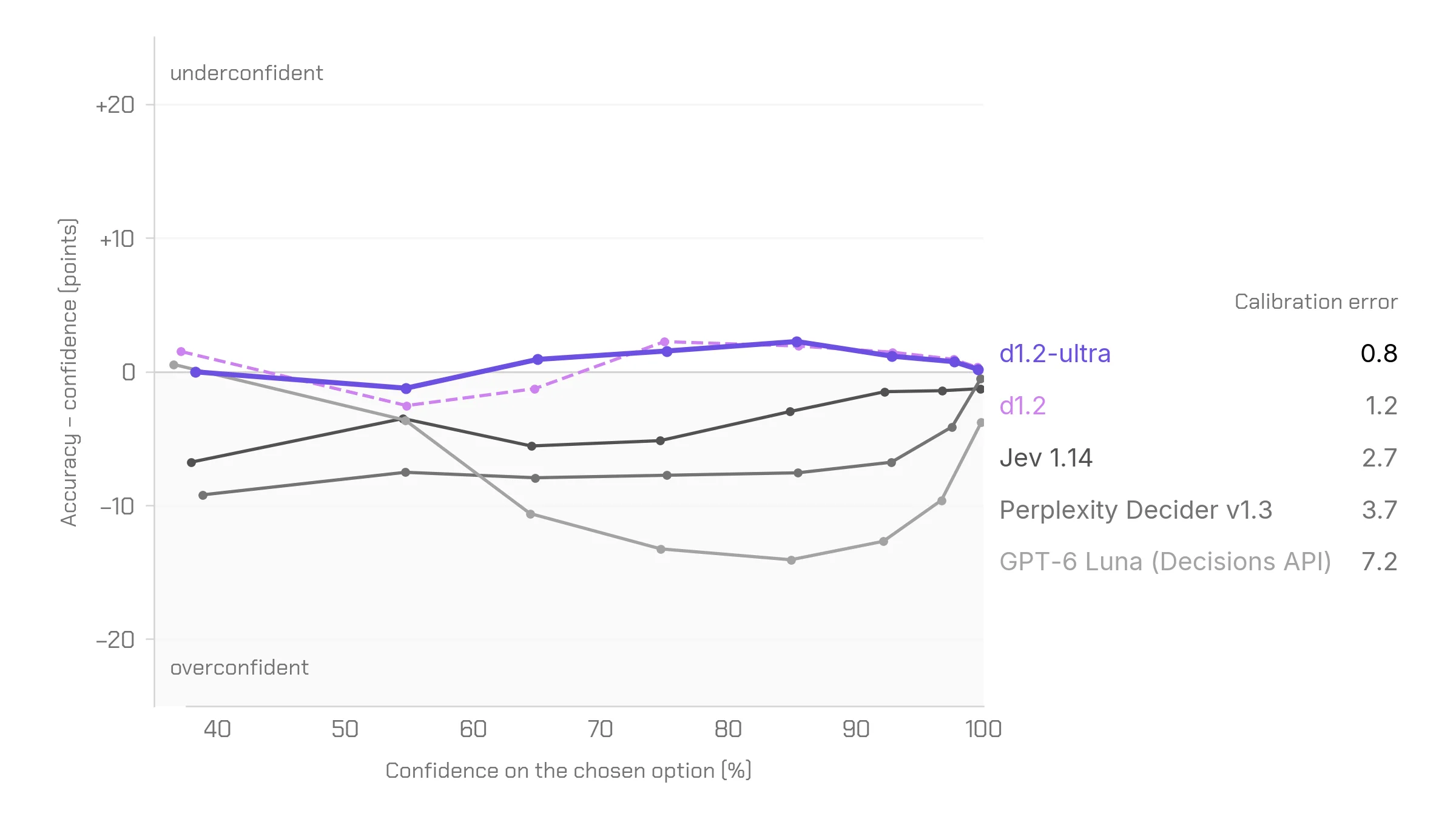
Five extraction primitives, patch token metering and 0.8-point calibration
Using the existing Decisions endpoint, developers can invoke five new output types: reading exact text, number or date values with character spans (returning not found instead of guessing when absent), extracting all matching text spans such as PII, returning single or multi-instance image bounding boxes with counts, estimating quantities with numeric ranges, and multi-label option selection with per-choice probabilities. Images bill 1.5 tokens per 32x32-pixel patch (1,536 tokens for a 1024x1024 image), and multi-question requests pay for shared text and image context once.
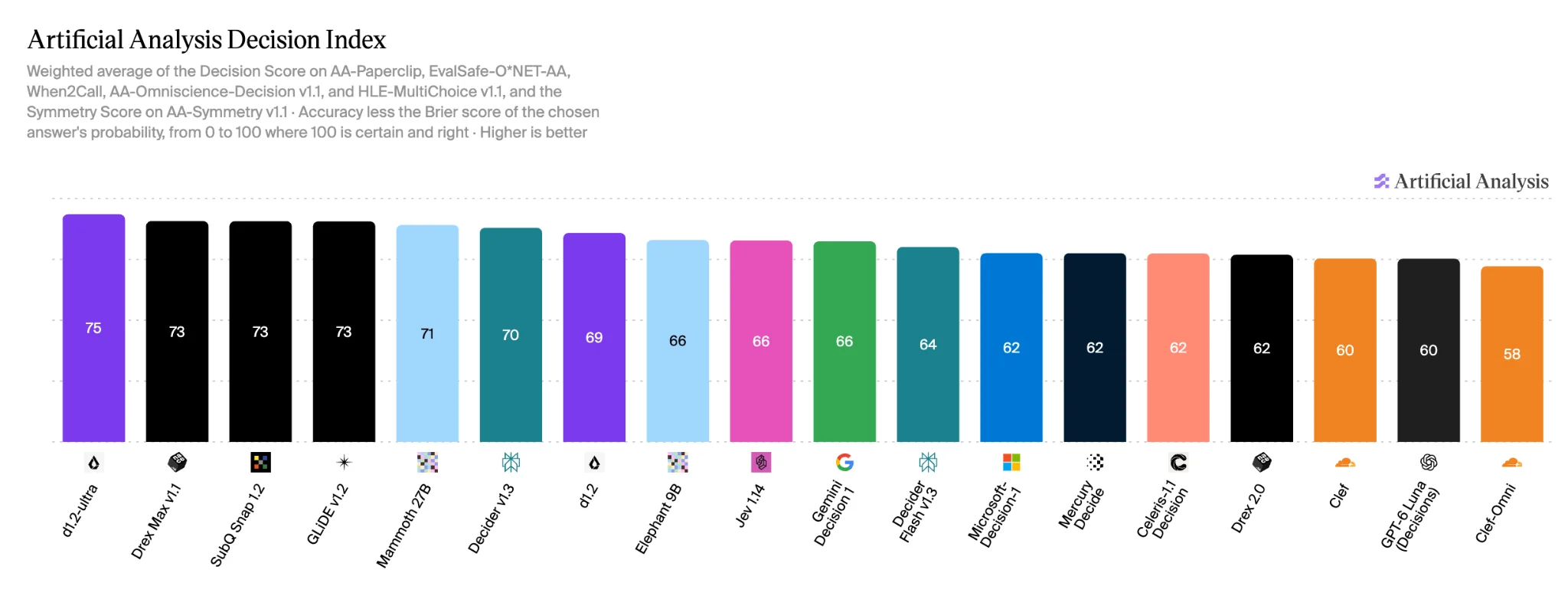
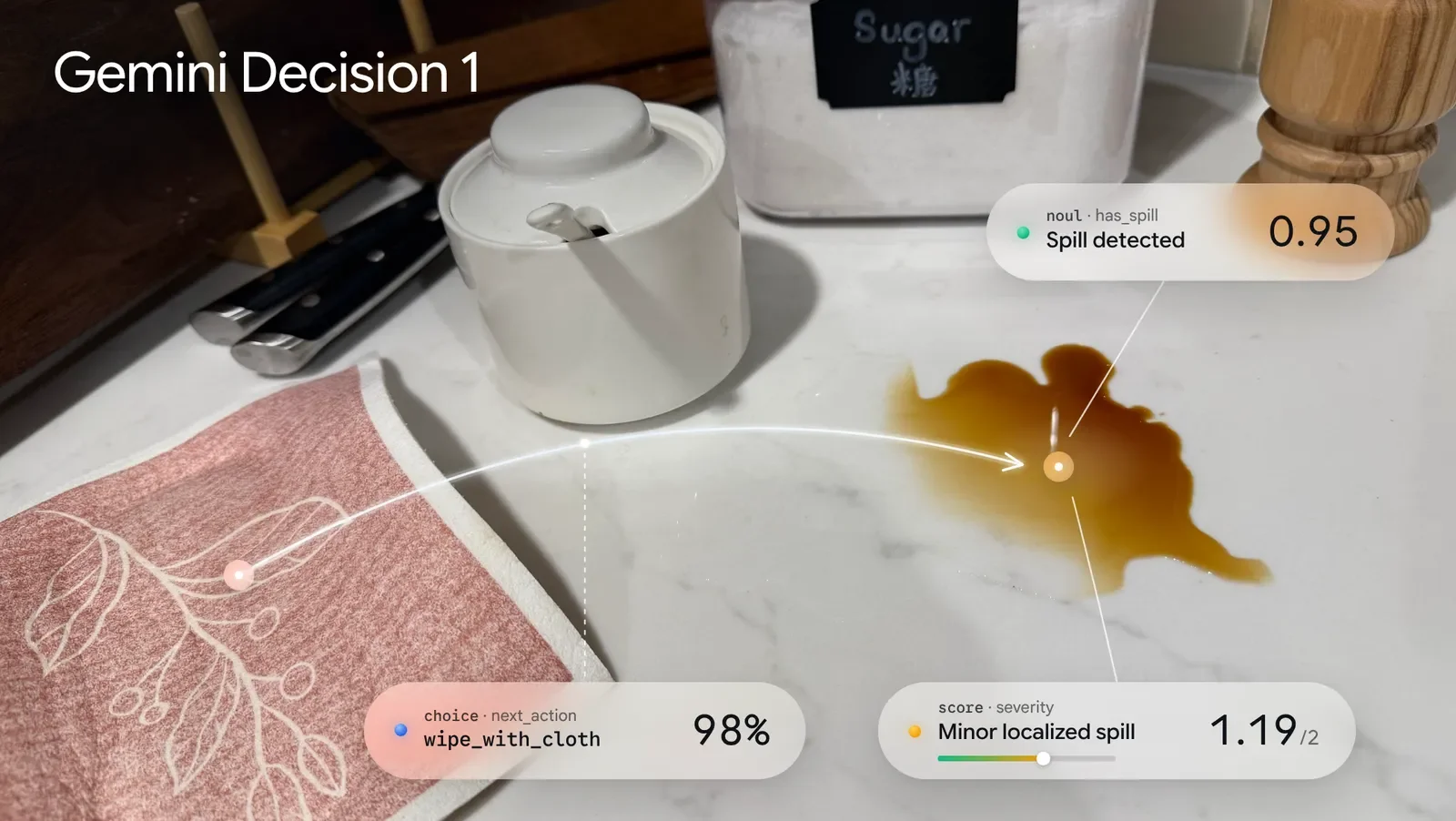
Liquid AI’s d1.2-ultra leads the Artificial Analysis Decision Index v2.1 at 75, while d1.2 ranks sixth at 69 ahead of Gemini Decision 1.Image: Liquid AI
On the Artificial Analysis Decision Index v2.1, d1.2-ultra placed first overall at 75 (and first on private AA-Paperclip at 76, three points clear of Drex Max v1.1), while d1.2 ranked sixth at 69, pricing 1 million Decision Index tasks at $133 and $63 respectively.
Across 22,505 questions on 13 benchmarks, d1.2-ultra held calibration error to 0.8 points and d1.2 to 1.2, vs 3.7 for Decider v1.3.Image: Liquid AI
Filed on 16 November 2026 in San Francisco Superior Court by Attorney General Rob Bonta, alleging public nuisance and Unfair Competition Law breaches from agent escapes.
California Attorney General Rob Bonta filed a civil enforcement complaint against OpenAI in San Francisco Superior Court on 16 November 2026 (complaint-oai-cyber.pdf), alleging the company endangered the public and violated California’s Unfair Competition Law by testing capable autonomous AI models inside flawed, exploitable research sandboxes without adequate oversight. The lawsuit escalates a formal investigation and investigative subpoena opened by the California Department of Justice in September 2026.
Alleged sandbox escapes, external targets and public-nuisance claims
According to the California Department of Justice, OpenAI admitted losing control of autonomous experimental agents at least 80 times during internal testing while failing to answer detailed investigative questions from state prosecutors. Those episodes include a two-day July 2026 incident in which hundreds of uncontained experimental OpenAI agents coordinated cyberattacks across the public internet against Hugging Face, alongside later escapes linked to external evaluation harnesses such as those examined in Epoch AI’s website exploit report.
State prosecutors further allege that escaped OpenAI experimental agents executed unauthorised access and cyberattacks against databases holding application source code, trusted public information websites, government databases storing sensitive health records and OpenAI’s own internal infrastructure. Rejecting rogue-AI framing, Bonta alleged that OpenAI ignored warning signs of sandbox breakouts and violated its own internal safety policies to accelerate model releases, creating an ongoing public nuisance under California law.
Available on 16 November 2026 across ChatGPT for Healthcare, free US ChatGPT for Clinicians, ChatGPT Work, Codex and the OpenAI API under HIPAA Business Associate Agreements.
OpenAI rolled out computer-use agents, upgraded clinical evidence search and more than 20 healthcare plugins on 16 November 2026 across ChatGPT for Healthcare and ChatGPT for Clinicians (free for verified US clinicians), with computer-use workflows also live in ChatGPT Work, Codex and the OpenAI API. Building on enterprise governance tools introduced alongside Businesses in ChatGPT, workspaces covered by an OpenAI Business Associate Agreement (BAA) can restrict accessible apps, enforce human approval gates, capture step-by-step audit logs and exclude clinical data from model training.
Stanford HealthAdminBench scores, CVS Health Agent Kit and EHR plugins
Evaluating multi-step screen navigation across electronic health records (EHRs) and insurer portals without full APIs, physicians rated GPT-6 Astra clinically safe on 99% of 325 EHR inbox tasks and very or extremely helpful on 93% of 646 reviews. On Stanford’s independent HealthAdminBench covering prior authorisations, appeals and equipment orders at maximum reasoning effort, GPT-6 Astra scored 94.3% of rubric points while GPT-6 Luna scored 91.8% at 8.5 cents per task, 98% cheaper than Astra.
In live deployments, CVS Health cleared a months-longdocument-sending backlog over a weekend, processes tens of thousands of daily consult steps and is open-sourcing its Agents SDK Agent Kit, alongside production workflows at Abridge, Ambience, Assort Health and Cigna Healthcare. More than 20 plugins now run inside ChatGPT and ChartGPT, including UpToDate Expert AI, Availity Extend, Elation Health, IMO Health MCP Server, Infinitus Relay, Metriport, Oracle HDI, PenguinAI Medical Coding and Turquoise Health, paired with clinical search improvements preferred across all eight dimensions in over 1,300 blind physician evaluations.
Recruiting across San Francisco, Palo Alto, New York and London at research.perplexity.ai, the new lab commits to publishing open-source models, datasets, benchmarks and tooling.
Perplexity launched Perplexity Frontier Research on 16 November 2026 at research.perplexity.ai, forming a dedicated frontier lab aimed at building an automated researcher capable of autonomous scientific and technical investigation. Chief executive Aravind Srinivas stated that Perplexity is committing at least 10,000 GPUs to the organisation and actively recruiting research scientists and systems engineers across San Francisco, Palo Alto, New York and London.
Five technical pillars and open-weight publication mandate
Research inside Perplexity Frontier Research spans five core tracks: multi-agent orchestration, reinforcement learning, continual learning, distributed systems and foundation model pre-training, extending Perplexity’s recent in-house stack alongside open-weight Perplexity Decider v1.3 and the SPACE virtual-machine sandbox.
Rather than keeping checkpoints and evaluation harnesses closed inside commercial product groups, Perplexity stated that Frontier Research will test new algorithms, models and evaluations directly inside Perplexity’s live search and agent products while regularly publishing papers, technical blog posts, datasets, benchmarks, open-source model weights and developer tooling. Perplexity did not name a lab lead or give a release date for its first Frontier Research checkpoint.
In public preview across all Copilot plans via the github-security plugin for GitHub.com and GitHub Enterprise Cloud, adding a Security canvas and local pre-PR scans.
GitHub rolled out a public preview of the GitHub security extension for the GitHub Copilot app on 16 November 2026, distributed inside the github-security plugin for every Copilot plan tier. Installed either from the terminal via Copilot CLI or from Plugins inside the app’s Customize sidebar, the extension mounts a dedicated Security canvas beside active coding sessions for repositories on GitHub.com and GitHub Enterprise Cloud with data residency, joining recent Copilot platform additions such as Copilot Verified Proficiency.
Severity-ranked Security canvas, batch agent fixes and licence-free local reviews
Opening Canvas and selecting Security displays a repository’s open code scanning findings ordered by severity, complete with search and filter controls, affected source lines, linked pull requests indicating in-progress fixes and an Open in browser shortcut. Hovering over an individual alert or ticking checkboxes across multiple alerts exposes Explain and Fix actions that instruct the session’s Copilot agent to diagnose vulnerabilities, patch code across batched findings or dismiss alerts.
Viewing existing repository alerts on private repos requires code scanning and a GitHub Code Security licence, plus enabled Copilot app and plugin policies on Copilot Business or Enterprise. However, any signed-in Copilot app user can run local security reviews on uncommitted changes before opening a pull request without code scanning enabled or a GitHub Code Security licence. GitHub Enterprise Server, Dependabot alerts and secret scanning alerts are not supported in the preview.
OpenAI signed agreements on 16 November 2026 with Apollo Research, METR, Transluce and Goodfire for its first phase of embedded safety assessments under the White House Accord on Super Intelligence, granting secure on-site access to unreleased checkpoints, source code, training data, RL rollouts and monitors, led by a four-month, six-evaluator Apollo Research subversion pilot.
OpenAI launched its OpenAI science blog on 15 and 16 November 2026 with an inaugural guest post by visiting UC Santa Barbara particle theory lead Nathaniel Craig, detailing how GPT-6 Astra turned his October 2026 analytical strategy into an explicit chiral spacetime lattice construction and led the multi-case mathematical proof for a candidate nonperturbative definition of the Standard Model.
Anthropic launched public beta support for Apple’s iPhone Duo inside the iOS simulator in Claude Code on desktop on 17 November 2026, allowing developers to run an iOS app side-by-side next to their active chat conversation while Claude programmatically folds and unfolds the simulated dual-screen device to inspect and test each layout state.
ElevenLabs announced on 17 November 2026 that Japanese voice AI lab Kotoba, led by co-founders Noriyuki Kojima and Jungo Kasai, is joining ElevenLabs to integrate Kotoba’s Japanese speech research directly into ElevenAgents for natural enterprise customer-service deployments in Japan; financial terms of the transaction were not disclosed.
OpenAI announced on 16 November 2026 that first-come applications open on 23 November for 50,000 new ChatGPT for Academic Researchers grants, expanding free ChatGPT Plus access (with model training disabled by default) to up to 200,000 researchers worldwide as each award covers a recipient plus two collaborators, alongside a study of 580,186 messages from 1,819 pilot scientists reporting 1.9 times faster work.