Announced on 2 November 2026, the fourth session mode in DeepSeek’s MIT-licensed desktop and local web agent harness generates, lints, themes and hot-installs custom interface plugins inside an active workspace.
Video: DeepSeek HarnessDeepSeek Harness Creator Mode generating and hot-installing custom workspace plugins and themes.
DeepSeek introduced Creator Mode in DeepSeek Harness on 2 November 2026, expanding its MIT-licensed desktop and local web agent environment so users can reshape the workspace itself through plain prompts. Built on the Cordis modularity framework (arXiv:2608.25512), DeepSeek Harness treats tools, model providers, skills, memory and visual panels as independent plugins rather than fixed application code.
Selecting Creator Mode in the session picker alongside Standard, PTC batch tool execution and Minimal terminal mode loads the cordis-plugin-development skill. When prompted for a new tool or panel, the agent inspects active runtime services and UI slots such as shell.overlay and conversation.view, writes the plugin code, checks it with node --check and oxlint, applies scoped interface tokens through ctx.theme.overrideTokens, and hot-reloads the extension into the live session without a restart.
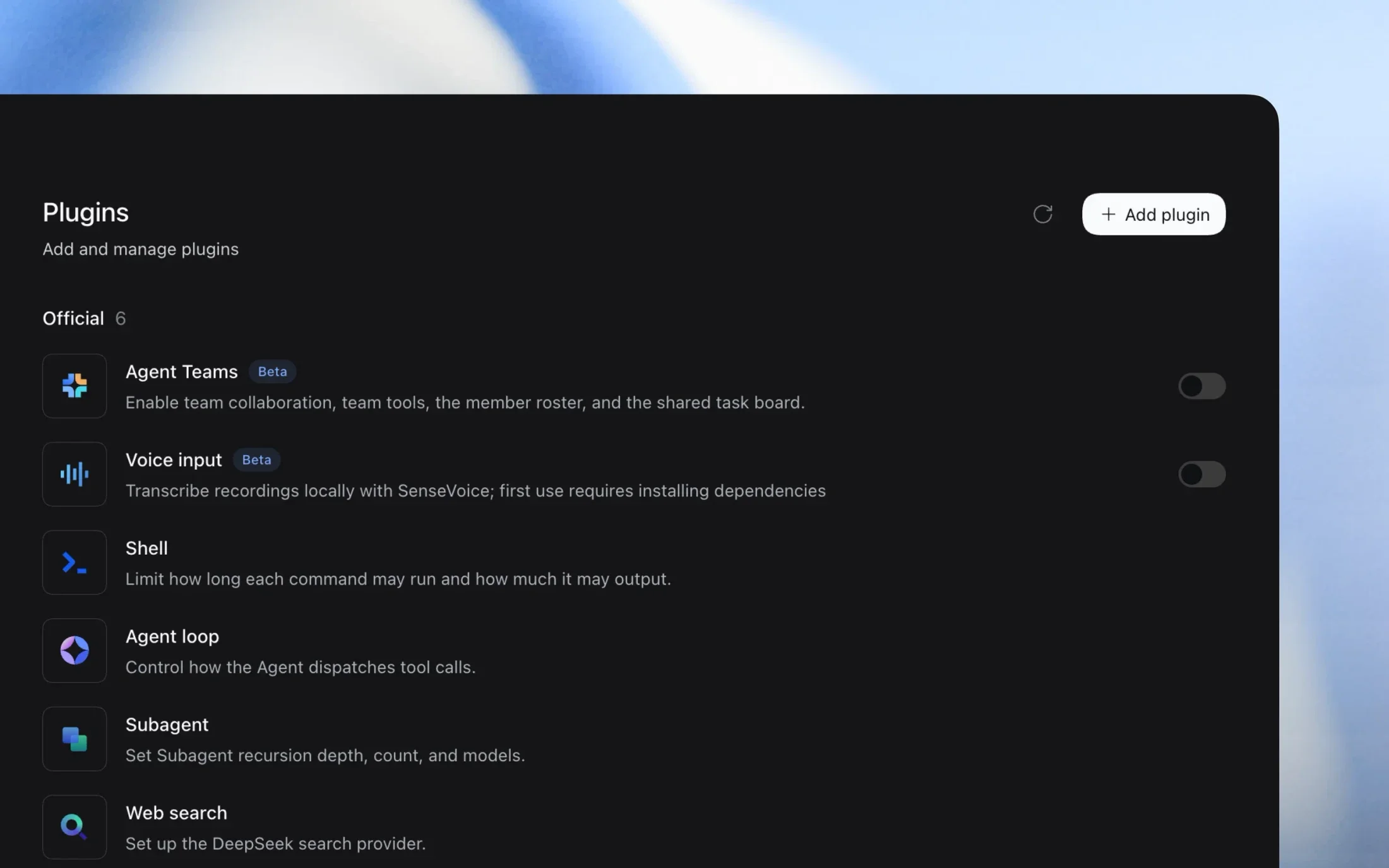
Every subsystem in DeepSeek Harness runs as a Cordis plugin that users can toggle or install locally.Image: DeepSeek
Showcase plugins and availability
DeepSeek’s launch video demonstrates seven custom interfaces built inside Creator Mode: a Style Lab theme editor, a Sticky Wall spatial canvas, a Poster Studio layout tool, a browser-style Video Editor, the Fuyu 3D voxel island sandbox, an arXiv paper annotator and an interactive Transformer 3D Lab. Desktop installers ship for macOS on Apple silicon and 64-bit Windows, while npx @deepseek-ai/dsh web serves the same interface locally on 127.0.0.1:3080 across Linux, macOS and Windows. Users connect their own API keys from DeepSeek or other model providers; DeepSeek charges no separate Harness licence fee.
Built on Z.ai’s GLM-5.3 and released under the MIT licence on 2 November 2026, Hydrogen-1.0 pairs laboratory notebook trajectories with reinforcement learning across molecular, materials and life-science workflows.
Deep Principle released Hydrogen-1.0 on 2 November 2026 as an open-weight foundation model for chemistry, materials science and life sciences. Post-trained from Z.ai’s GLM-5.3 using supervised fine-tuning and resumable reinforcement learning across Megatron and SGLang on NVIDIA CUDA and AMD ROCm clusters, the model trains on curated scientific corpora, electronic lab notebook records and multi-step discovery trajectories generated with Deep Principle’s Mira agent.
Unquantised BF16 checkpoints and separate NVFP4 and MXFP4 quantised repositories are available on Hugging Face and ModelScope under the MIT licence, alongside Apache 2.0 inference guides, hosted access on the NeuroSpark API and integration in the Mira AI Scientist platform. Deep Principle renders its benchmark comparisons dynamically on HTML canvas rather than static chart images, reporting leads on scientific computing and forward reaction prediction while trailing GPT-6 Astra by 3.33 points on nuclear magnetic resonance structure elucidation. Deep Principle has not published per-token NeuroSpark API pricing in the launch announcement.
Key numbers
38.3% on FrontierScience-Research, ahead of GPT-6 Astra at 33.3%, plus 93.0% on GPQA-Diamond.
5.13 points ahead of GPT-6 Astra (max thinking) on scientific computing and 4.76 points ahead on forward reaction prediction.
4.318 eV mean HOMO-LUMO gap after five closed-looptransition-metal design rounds, versus 3.689 eV for GPT-6 Astra and 3.353 eV for Kimi-K3.
Full BF16, NVFP4 and MXFP4 weights released under the MIT licence on Hugging Face and ModelScope.
Grounded in government time-use diaries and a survey of 3,995 people, the evaluation published on 2 November 2026 measures browser use, computer use and connectors across seven personal-life domains.
OpenAI introduced LifeVal on 2 November 2026 to measure how AI assistants handle practical household and personal administration rather than coding or academic exams. To construct the suite, OpenAI paired data from the American Time Use Survey and the Multinational Time Use Study with a demographically representative survey of 3,995 respondents asking where unpaid personal tasks consume the most time and effort.
The resulting multi-step scenarios span seven categories: caregiving, health, education, household administration, personal finances, shopping and government services. Completing a task requires an agent to combine web browsing, desktop computer use and external connectors while respecting constraints such as municipal deadlines, school catchment rules, dietary restrictions or county property portals.
In walkthrough examples drawn from what OpenAI calls its current models without naming a specific checkpoint, scores reached 100% on a Luzerne County home search and deed-record lookup, 98.0% on flood-volunteer coordination, 96.3% on setting up a remote sports watch for an elderly relative, 93.1% on shortlisting local kindergartens and 90.4% on assembling a diabetes care and meal plan. OpenAI uses LifeVal internally alongside GDPval and has not released the task dataset or a public leaderboard repository.
Detailed in a 1 November 2026 technical report and opened on the LongCat API on 2 November 2026, the Mixture-of-Experts model activates roughly 48B parameters per token across text and native-resolution images.
Meituan published the LongCat-2.5 technical report on 1 November 2026 and enabled API access on 2 November 2026. The Mixture-of-Experts architecture totals 1.6 trillion parameters with roughly 48 billion active per token. Instead of bolting a continuous vision encoder onto a text backbone, Meituan pre-tokenisesnative-resolution images offline through Residual Vector Quantisation into discrete visual tokens, removing the online vision encoder from training and balancing multimodal batches across sub-80 GB domestic AI accelerators.
Post-training combines asynchronous partial-rollout reinforcement learning with Multi-teacherOn-Policy Distillation using Tree Attention across Claude Code, Codex and Hermes agent harnesses. For serving, native INT4 W4A4 quantisation raises prefill throughput by 43.3% and decode throughput by 42.77% over W8A8 while cutting time per output token by 19.72%. Meituan draws its score tables interactively on the report page rather than static chart files. LongCat-2.5 is live on longcat.ai/chat and the OpenAI- and Anthropic-compatible api.longcat.chat endpoint; open-weight releases on GitHub and Hugging Face are listed as coming soon, and per-token API rates are not printed in the report.
Key numbers
1.6 trillion total parameters with roughly 48 billion activated per token.
88.4 on Terminal Bench v2.1, 91.9 on BrowseComp and 83.1 on MCP Atlas.
55.4 on 3DCodeBench Text-to-3Dvisual-programmatic synthesis.
43.3% higher prefill throughput and 42.77% higher decode throughput with native INT4 W4A4 versus W8A8.
Launched in public beta on 2 November 2026, message threads keep conversation state in encrypted server memory for five minutes so subsequent turns transmit only new messages and cut median time to first token by roughly 35%.
Anthropic launched server-side message threads in public beta on the Claude Messages API (beta header message-threads-2026-08-12) on 2 November 2026. Long-running coding and tool-use agents typically re-upload hundreds of thousands of conversation, system and tool-schema tokens on every turn, creating network upload, JSON parsing and validation overhead before inference even starts.
Creating a server-side thread stores the conversation history, system prompt and tool definitions in encrypted server RAM without writing them to disk. Follow-up calls pass previous_message_id and transmit only the new user or tool-result messages, supporting up to four cache_control breakpoints. Thread state expires after a rolling five-minute idle window and is permanently deleted within one hour; if a thread expires, the API returns a 404 thread_not_found error and Anthropic’s updated SDKs automatically replay the full local history.
Key numbers
Roughly 35% lower median time to first token on 500k to 1M token requests.
Rolling 5-minute idle expiry in encrypted RAM, with hard deletion within 1 hour and zero disk writes.
Up to 4 cache_control breakpoints per threaded request.
Standard Messages API per-token rates apply, with Zero Data Retention and HIPAA workloads excluded.
Published on 2 November 2026, OpenAI’s custom distributed Git storage engine replaces global reference locks with per-branch causal consistency and trims median monorepo push latency by almost five times.
OpenAI engineering published the architecture of Pando on 2 November 2026, detailing how it rebuilt internal Git hosting after parallel Codex coding agents pushed reliability on its legacy monorepo backend below 90%. Conventional replicated Git servers serialise reference updates through three-phase commits or a shared write-ahead log, turning millions of short-lived agent branches into a global lock bottleneck and inflating reference advertisements past 100 MiB.
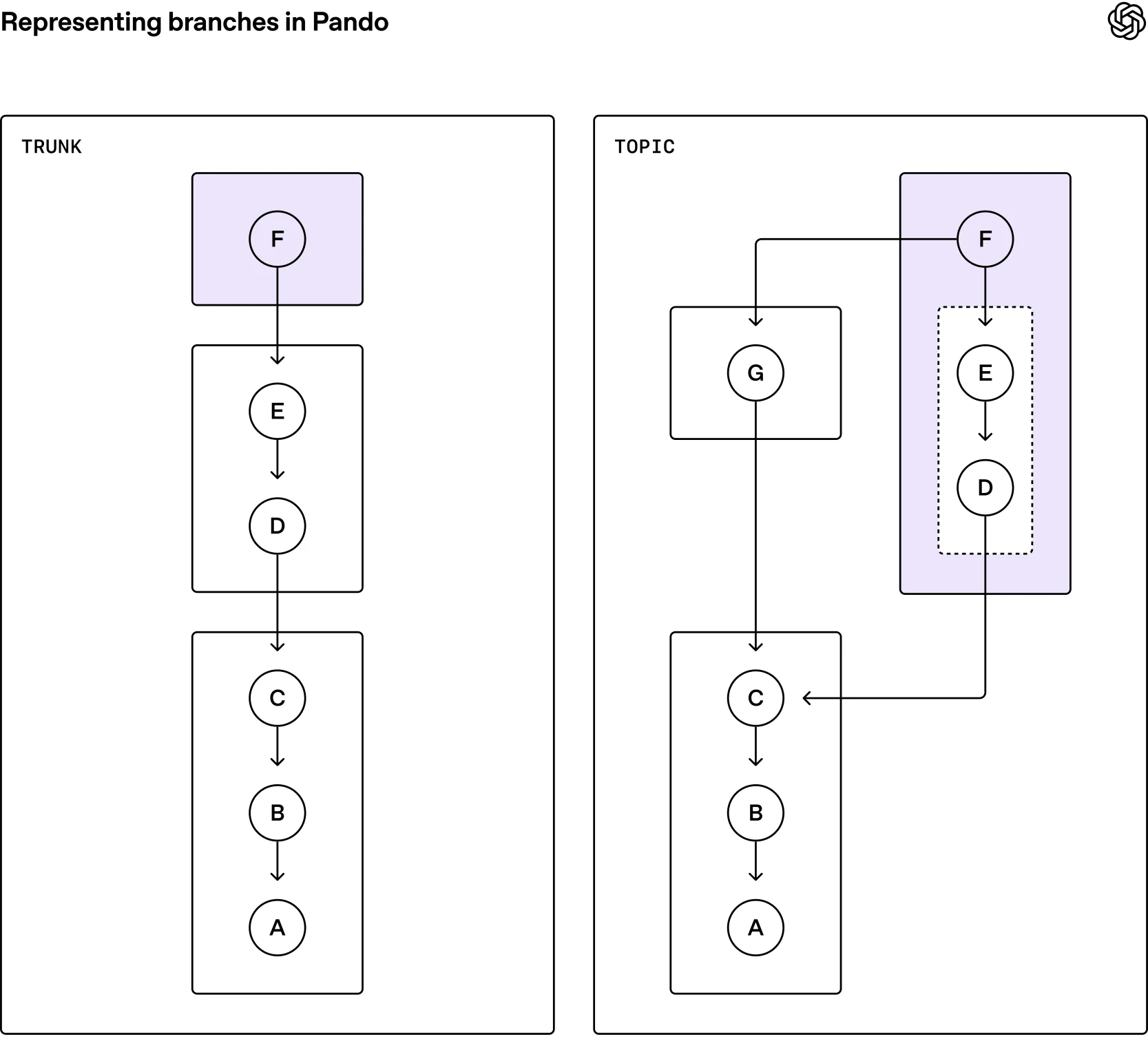
Pando separates immutable packfiles in horizontally scalable blob storage from per-branch metadata logs enforced under causal consistency rather than global linearisability. When a developer or Codex worker pushes to a feature branch, Pando advertises only a designated trunk branch so clients upload thin deltas, keeping median push packfiles below 20 KiB and 99th-percentile pushes under 3 MiB. Fetch traffic reads immutable cached packfiles directly, hitting local disk caches on more than 99% of requests.
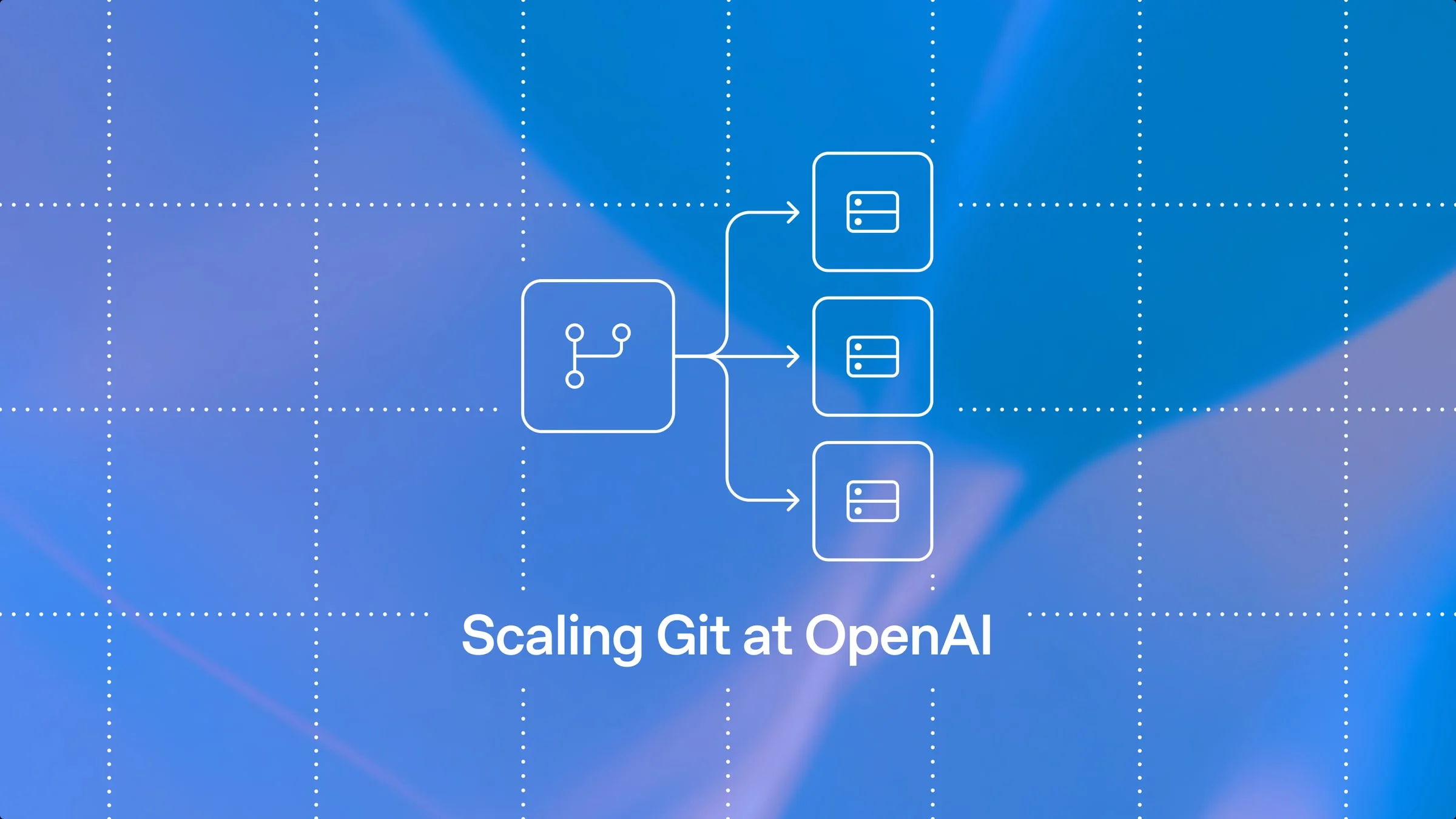
Pando separates immutable packfile blobs from per-branch metadata logs so pushes on separate branches never contend on a global lock.Image: OpenAI
OpenAI has contributed client-side patches including parallel pack indexing and explicit force-with-lease object negotiation upstream to Git, while keeping the Pando server infrastructure internal.
Key numbers
Nearly 5 times lower median Git push latency (roughly an 80% reduction).
Nearly 1 PB of Git data served per day, peaking above 57 TB in a single hour.
Under 20 KiB median push packfile size and under 3 MiB at the 99th percentile.
Over 99% local disk cache hit rate on packfile fetches.
An Amendment No. 1 to Form S-1 filed with the US Securities and Exchange Commission on 2 November 2026 shows third-quarter revenue jumping more than 12 times year on year alongside $895.4B in compute commitments.
Anthropic filed Amendment No. 1 to its Form S-1 registration statement (Registration No. 333-299633) with the US Securities and Exchange Commission on 2 November 2026, adding financial results through 30 September 2026. Third-quarter revenue reached $16,956 million, up 47% sequentially from $11,555 million in Q2 2026 and 1,127% above Q3 2025’s $1,382 million. Nine-month 2026 revenue totalled $33,242 million, with 79% ($26.3 billion) coming from consumption-based API and cloud usage.
Compute and infrastructure costs rose 382% year on year to $9,863 million in Q3, pushing GAAP operating results to a $567 million loss after $5.0 billion in higher-costshort-term compute capacity and $2.0 billion in non-cashdonation-matching charges. Excluding share-based and non-cash items, non-GAAP Adjusted Operating Income was $2,463 million (a 15% margin), while GAAP net loss reached $23,291 million after a $21,936 million non-cashfair-value remeasurement on convertible notes and SAFEs. Anthropic ended September with $95.6 billion in cash and $36.3 billion in marketable securities, and left its IPO share count and price range blank.
Key numbers
$16,956 million in Q3 2026 revenue (up 1,127% year on year) and $33,242 million across the first nine months of 2026.
$2,463 million in Q3 non-GAAP Adjusted Operating Income versus a $567 million GAAP operating loss.
$95.6 billion in cash and cash equivalents plus $36.3 billion in short-term marketable securities as of 30 September 2026.
$895.4 billion in cumulative multi-year compute and lease purchase commitments, including $69.8 billion due within 12 months.
Runway launched official Runway Dev plugins for Claude Code (/plugin install runway-api@claude-plugins-official), Codex and Cursor (/add-pluginrunway-api) on 2 November 2026. Authenticated over browser OAuth through Runway’s MCP server with no local API keys, the plugins inspect account models, pricing and credit balances, configure Characters, Recipes, Workflows and Model Routers, write SDK code and debug failed generation tasks.
OpenAI announced an internal security sprint on 2 November 2026 with offensive security firm Cathedral, written Cathedral Systems in OpenAI’s X post, using frontier OpenAI models to probe internal infrastructure following an earlier sprint where 25% of product engineers used Codex. OpenAI also more than quadrupled critical bug bounty payouts up to $172k alongside $1 billion in six-month Daybreak cyber-defence credits.